Semiconductor Breakouts Need Confirmation and Cash Discipline

US Stocks · Options · News · Views
Fourth-Quarter Breadth Begins to Improve
The three major indexes edged higher on October 1. The S&P 500 gained about 0.19%; the Dow and Nasdaq each added about 0.04%. The S&P 500's outperformance suggests that the day's gains reached beyond technology heavyweights. A single session does not establish a broad rotation, though. Semiconductors remain the clearest area of strength to watch.
Three developments deserve separate treatment. SMH has broken above a key level, while SOXX still needs confirmation. Nike delivered better quarterly profitability but lowered expectations for the full year. Anthropic's potential listing puts rapid growth alongside substantial future computing costs. Opportunities are emerging in the fourth quarter, but entry conditions need to be specific.
Semiconductors: A Breakout Still Needs a Successful Retest
SMH closed near $617, above resistance around $613. A close above resistance carries more weight than a brief intraday move through it. The next test is whether $613 becomes support: buyers need to show up on a pullback and keep the price above that level into the close.
The $591–$613 range offers two different checks. The upper end tests the recent breakout; the lower end tests the deeper structure. A brief move back into the range, followed by a recovery above $613, would leave the breakout open to further confirmation. A loss of $591 that goes unrepaired over the next several sessions would weaken the case. These levels guide a trading decision. They do not guarantee protection.
SOXX closed near $576.3, just below the $577 confirmation level. A higher opening the following day would not substitute for a close above it, and after-hours trades above the line would not establish a completed breakout. The stronger sequence would be a close above $577, then buying on a retest. The old high near $655 offers historical context; it is not an assured destination.
For both ETFs, price gains also need to be weighed against the risk of diverging RSI momentum. Divergence can resolve through further gains, sideways trading, or a pullback. It raises the burden of confirmation without setting a timetable for a decline.
Options make that distinction especially consequential. An investor can get the underlying asset's direction right and still lose money on a near-expiry call because the move takes too long, implied volatility falls, or time value erodes. A previous high says nothing about the speed of the advance or the time available for it.
Nike: Better Quarterly Profit, Lower Full-Year Expectations
NKE reported fiscal 2027 first-quarter revenue of $11.21 billion, down 4.2% year over year and below expectations. GAAP EPS of $0.48 beat an estimate of about $0.44. Gross margin rose to 42.8% from 42.2% a year earlier. Sales pressure and better margins appeared in the same quarter, so describing the entire report as deterioration would miss part of the picture.
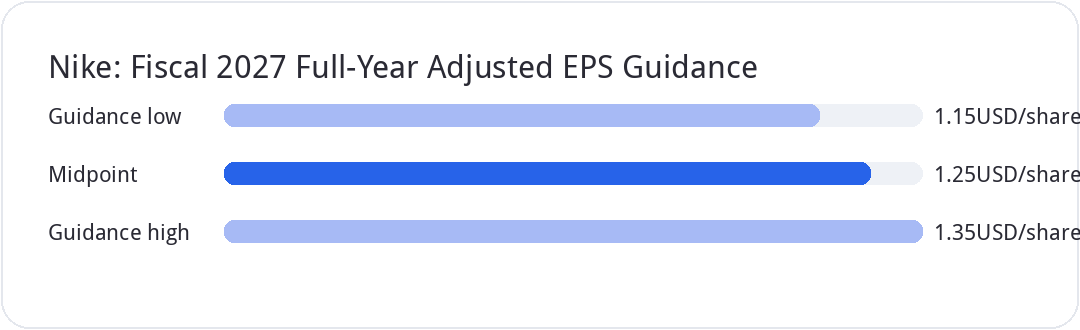
The larger concern is the outlook. Nike guided to fiscal 2027 full-year adjusted diluted EPS of $1.15–$1.35, with a $1.25 midpoint, and a high-single-digit decline in full-year revenue. That lowers the future earnings base against which investors must assess valuation. The quarterly GAAP result and the full-year adjusted guidance cover different periods and accounting measures. Subtracting one from the other would be misleading; $1.25 is not the quarter's reported EPS.
Inventory was about $7.8 billion. That is one component of cash tied up in the business. Even a lower-than-expected inventory figure would not, on its own, prove that cash flow had improved. Promotions, channel sales, operating cash flow, and one-time adjustments still need scrutiny before the margin recovery can be called sustainable. Converse's weakness also points to an uneven recovery across the group.
The sharp after-hours decline was consistent with pressure from the full-year outlook, but its size depends on when it is measured. An after-hours quote is not the next day's closing price. The historical range around $31.2–$34.9 may help frame the chart, but distant trading history does not establish current demand. A fresh consolidation, sustained buying, and an end to earnings downgrades would be more useful evidence.
Anthropic: Revenue Growth and Funding Needs Belong Together
Reports suggest Anthropic could begin an IPO roadshow as early as November and start trading before Thanksgiving. Both the timetable and final pricing remain subject to change. Valuations being discussed are not completed financing prices. Until a listing date is confirmed, this is a possible catalyst, not a certain funding inflow.
Reported 2025 figures show about $4.6 billion in revenue, more than $8 billion in operating losses, and nearly $42 billion in net losses. More than $34 billion was associated with changes in the fair value of liabilities. The full net loss therefore cannot be equated with cash burned in ordinary operations that year. Excluding that accounting effect would not make the business self-funding; the operating loss still needs its own assessment.
The roughly $518 billion in future computing and infrastructure commitments requires a similarly careful reading. It represents spending across future periods, rather than orders Anthropic has already received or capital expenditure all due in a single quarter. Funding needs would rise if revenue developed more slowly than expected while purchasing and payment commitments proved difficult to reduce. Cash constraints would ease if revenue and gross-profit growth could cover continuing investment.
Annualized revenue also differs from realized full-year revenue. Extrapolating one month's pace over twelve months can show the direction of growth. It does not establish full-year cash receipts or profits over the years ahead. Customer retention, inference costs, gross margins, and cash conversion all need to support a high valuation.
Publicly traded cloud and chip partners have exposure to the same story, but the financial effects depend on contract terms, delivery, payment, and profit recognition. Better funding prospects can lift expectations. Sustainable supplier profits require further evidence. Purchasing commitments still carry credit and execution risks before they become realized earnings.
Lower Yields Help, but Oil Remains a Variable
Treasury yields fell on October 1, with the ten-year yield near 5.24% in late New York trading. The decline gave richly valued assets some breathing room, but yields remained high. A day's relief does not remove financing pressure.
Oil strengthened again as Middle East risks increased, creating a potential source of inflation and higher corporate costs. Falling yields and rising oil could continue to pull risk appetite in different directions.
The October 2 employment report is the next key release. Payroll growth, unemployment, wages, and revisions need to be read together. Strong hiring could support demand while pushing policy easing further out. Weak hiring could reduce rate pressure while raising concerns about corporate earnings. A single headline number cannot settle the outlook for every asset.
Conditions for the Next Three to Five Sessions
The bullish case needs SMH to reclaim roughly $613 by the close after a retest, SOXX to close above $577 and hold it, and gains to spread across the sector. Those confirmations would strengthen the case for improving risk appetite. A quick reversal below the key levels, followed by closes that fail to recover, would invalidate that view.
The neutral case has both ETFs circling their key levels while yields and oil offer conflicting signals. Waiting for retests and for investors to absorb the employment data would make more sense than chasing because seasonal statistics look favorable. Sustained support or a clear breakdown would end the range-bound assessment.
The bearish case needs SMH to break below $591 and struggle to recover, SOXX to remain blocked at $577, and rates or earnings expectations to add valuation pressure. Technical failures and fundamental repricing could then reinforce one another. Reclaimed levels and buying that holds into the close would invalidate this case too. Setting those conditions in advance gives investors a basis for adjusting exposure as the evidence changes.