A light-volume dip is not the new risk, and SpaceX is borrowing again for chips

US Stocks · Options · News · Views
The dip shrank in volume
Wednesday was a down day across the four indexes. The Russell fell the most. Inside the S&P 500, 361 names fell and 138 rose. Only health care finished higher. The other ten sectors fell. Industrials dropped 2.1%, and CAT fell more than 5%, the worst Dow name of the day.
After several up days, a down print gets read as risk coming back. As of Wednesday, it is not. Outside the Russell, the other three indexes traded even less than Tuesday. A small decline on shrinking volume is usually noise.
The things that matter are the hike in the minutes, and the new SPCX debt.
The minutes backed the September hike
Everyone at the September meeting, voters and non-voters, supported the 25 basis point increase. Most thought another hike before year-end could be appropriate. Inflation is still high, the labor market looks close to full employment, and the inflation risk is to the upside. Some participants said that upside has become clearer in recent months. A few also said AI buildout could push demand ahead of supply over the medium term and add to inflation. The rise in long-term Treasury yields was pinned mainly on real rates. TIPS moved up with them.
The New York Fed's consumer survey came the same day. Median one-year and three-year inflation expectations edged up to 3.9% and 3.3%. The one-year figure is the highest since May 2023. The five-year stayed at 3%. The mean unemployment expectation fell 0.5 percentage point to 43.9%. The average probability of job loss over the next 12 months fell to 13.5% from 13.8%, the lowest since December 2024. Expected household income growth rose to 3.1% from 3.0%, the highest since February 2025. Perceptions and expectations of household finances both worsened.
The minutes leave another hike on the table. That is a valuation constraint for growth. It is a separate question from one light-volume down day.
SPCX wants to borrow again for chips
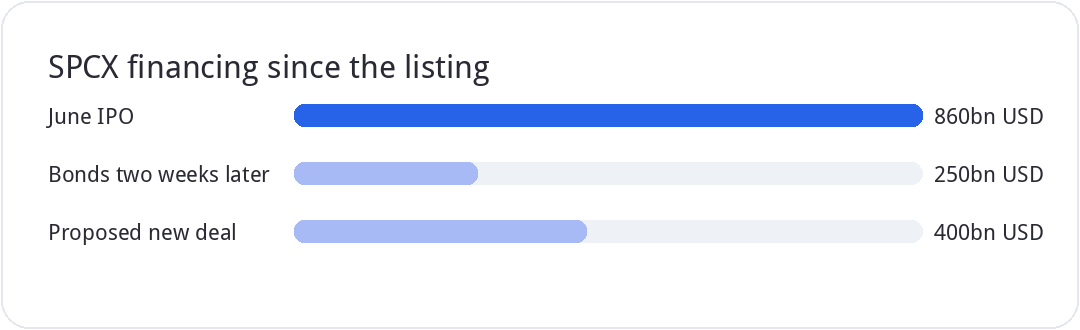
The Financial Times says SPCX is lining up another 40 billion dollars through an Apollo-led special purpose vehicle, to buy NVDA chips. About 10 billion would be bank loans and 30 billion investment-grade bonds. The June IPO raised 86 billion. Less than two weeks later the company sold 25 billion of investment-grade bonds. If this deal lands, debt raised or about to be raised since the IPO is 65 billion, about 76% of the IPO proceeds.
The 2056 bond is down to 84.7 cents. It was issued in June, as part of that 25 billion senior unsecured deal, at 98.83 cents. Credit default swaps rose 16.2 basis points to 197.56, a record. That CDS price looks like junk. The rating is still one notch above junk. The price has moved to a junk tape. The rating has not.
Starlink had 13.5 million consumer users worldwide as of September 26. September adds were 372,000, below August's 600,000-plus, the low since March. The add curve is jagged. One slow month is not a trend break. For bond buyers the point is narrower: Starlink makes money, and the current pace of revenue still does not cover the chip spend. Borrowing against NVDA chips is likely to become a habit. The prospectus is clear that the big valuation piece is the combined xAI business, not launches, and not Starlink on its own.
Data centers and power assets are all issuing. Investment-grade paper bought in June can already be deeply underwater. SPCX is the example.
The stock has been public for less than a year, so support and resistance have not been tested enough. The heaviest trade is 140 to 155, then 100 to 120. Overhead supply is unclear because the history is short. Some of it may already have been sold on this decline. Tuesday was a stall with a record close, which reads neutral. Wednesday's debt headline took it down 2.51%, and it is still a stall. Closer to 155 it starts to look like support. How far it can fall is not knowable if short-term money heats up.
Holders from 100 to 120 can sit. Buying 140 to 155 again is like buying the IPO day a second time. That is not a short-term trade.
Apple's home devices will not move the earnings much
Bloomberg says AAPL is working with LG Electronics on a wider smart-home line. A launch as soon as next Tuesday could include doorbells, locks, thermostats, indoor and outdoor cameras, and floodlight cameras. Amazon and Google already sell some of these. Apple's old home lineup barely touched locks and cameras. Ternus, who spent about 20 years on core product design and hardware engineering, thinks the home should not stop at the television and the home hub.
Phones, tablets, and computers do not have much left to invent. New models are mostly processors and hardware. A new line is useful. The hardware market is small next to Apple's revenue, on the order of a few hundred billion, and Apple will not take all of it. Doorbells and locks at 20% to 30% gross margin would already be decent. Security tied to alarms and monitoring can run 60% to 80%. Near term this is a positive headline. It will not lift results much.
The forward view is unchanged. A lot of the EPS lift is buybacks. Growth is slow, and the price is already high. The September 2027 forward value is 288. After the fourth-quarter report, the model rolls to September 2028. At 330, the stock is already near the top of that forward value.
On the chart, 326 to 339 is medium support, not the key. The key is 305 to 317. A break of 326 opens a chop from 305 to 339. A break of 305 is the bearish turn, with 281 and below in view. The forward value can support a move back under 280. If 305 holds, it keeps chopping.
The home launch does not change the fact that 330 is already at the forward ceiling. Watch 305. Do not trade the break before it happens.
Meta is back in 690 to 730, and today is not the buy
META fell about two points. The 690 to 730 band is the pullback zone after the breakout. Holding it keeps the structure pointed at a new high. A pullback into support is not a one-way rise. Wednesday was a full-bodied down candle, with no reversal and no defense intraday. That is not a buy. It is only a return to the zone. A buy needs a later sign that the decline has stopped.
A break of 690 opens a chop from 656 to 730. That is still not a bear trend. The trend change is a break of 656. A right-side trade back to the old high waits for a stop inside 690 to 730. Longer money can also look at 656 to 680. The older 500 to 700 band is the long window, and the path in between is not straight.
Wednesday did not break a key level. Do not treat a return to 690 as a completed buy.
CAT fell 5.75%, and the headline was not about CAT
CAT fell 5.75% as industrials were sold. It is a large weight, so a sector sale hits it. The Federal Trade Commission and the Agriculture Department asked the public on Wednesday for information on competition in farm-equipment manufacturing and distribution. That is not a monopoly finding against CAT, and nobody was fined. Deere is the purer agriculture name, and it fell less. CAT itself does not have much farm business. Industrial and electrical equipment matter more.
The price is the problem. The 2027 forward cap is 817 to 814. After the drop the stock is still 813. The group is weak, so it gets sold, and some of that is profit-taking. It is not in a downtrend yet. Mean reversion starts under 798, and it has not broken. If it holds, it stays expensive. A break opens a path under 720. Even 671 to 720 is still rich. A more reasonable zone is just above 600, with 546 to 606 below that.
The power-equipment upcycle has stopped being revised higher. A year out, some of those forecasts are already flat or down. That is the cycle.
Until 798 breaks, this is not the mean-reversion trade. The Agriculture Department request is not a CAT penalty.
Midterm fourth quarters rose 21 times out of 23
Deutsche Bank counted the S&P 500 in the fourth quarter after the last 23 midterms. It rose 21 times and finished the quarter lower twice. Fourth quarters are a strong season with or without a midterm. The average gain is about 7%, and the last few years pull that average up. A 7% average is not a forecast for this year.
The quarter can be volatile. A midterm year is not an instruction that the fourth quarter must fall.
Seasonality is still there. Do not use 7% as the target. Volatility and a light-volume down day are two different ledgers.