Semiconductors Rebound as Big Tech Faces a Funding Test

US Stocks · Options · News · Views
Treat the move as a rebound
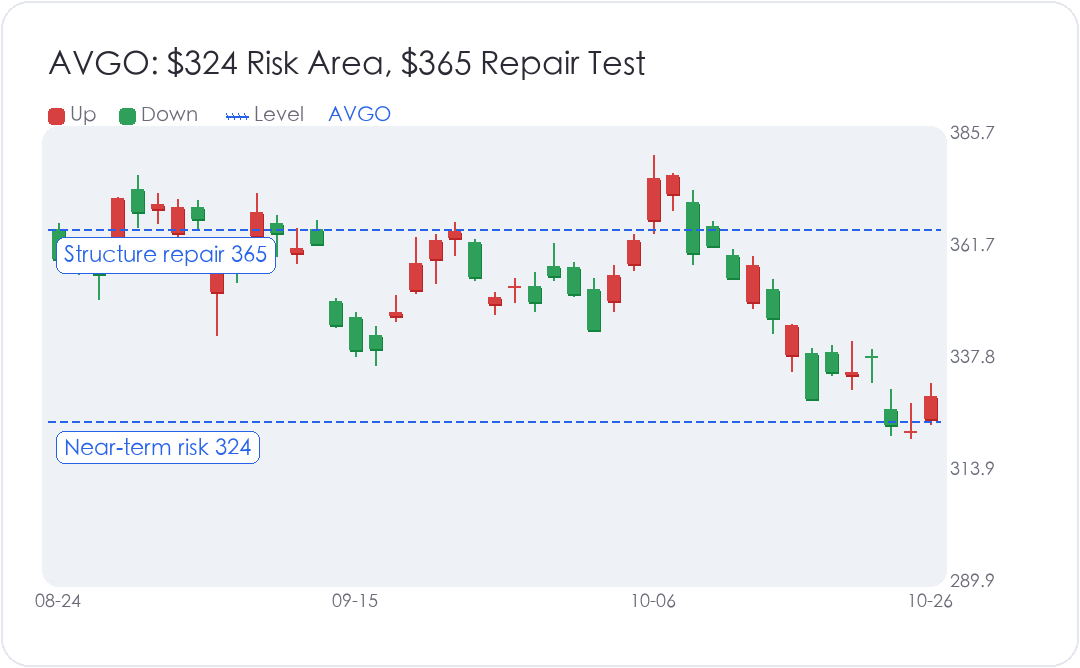
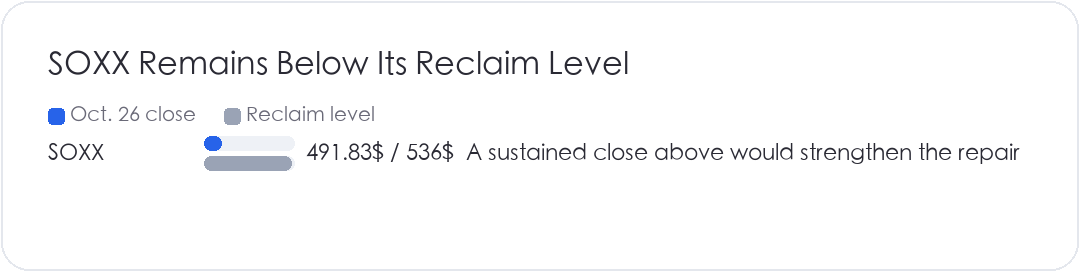
Treat Monday's semiconductor gains as a rebound. SOXX closed October 26 at $491.83, up 2.85%, but the structural reclaim level remains $536. AVGO finished at $329.17 and needs to recover $365 for a clearer repair signal. Demand news brought buyers back, while the earlier breakdown remains unresolved.
The S&P 500 gained 0.7%, the Nasdaq 0.8%, and the Dow 0.3%. QQQ advanced 1.11% to $712.20, while the VIX fell from 19.45 to 18.39. Demand for protection eased, giving the market some breathing room. Meta's funding plans, Anthropic's compute agreements, and SpaceX's GPU financing commitment are consistent with the semiconductor rebound, but each has different constraints. Funding, delivery, and collection still have to follow the improvement in order expectations.
Meta's funding plan is still taking shape
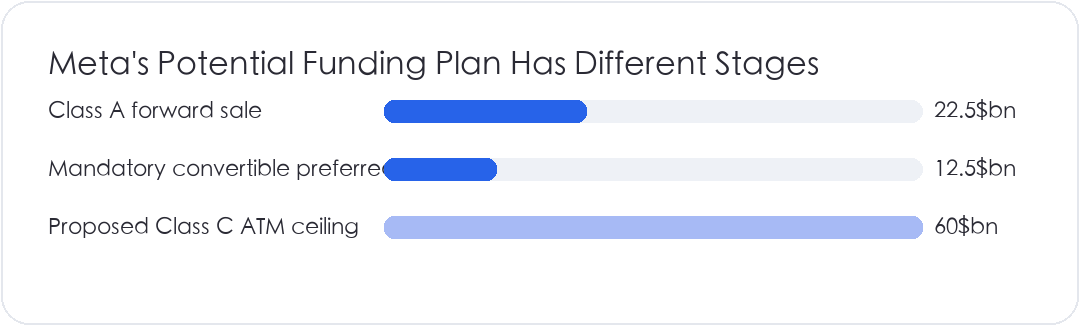
META launched roughly $35 billion of offerings: $22.5 billion of Class A common stock through forward sales and $12.5 billion of depositary shares representing mandatory convertible preferred stock. A separate Class C at-the-market program could raise up to $60 billion. It is expected to begin no earlier than the first quarter of 2027, after Class C shares start trading, and no distribution agreement has been signed. The combined $95 billion is a potential plan that still has to be implemented in stages.
The timing of cash receipts also differs. Meta initially receives no cash from the Class A forward sale; proceeds come with future settlement. The preferred stock's final dividend and conversion terms remain subject to pricing. Common issuance, eventual conversion, and returns on the new capital all affect per-share value. The potential funding amount gives the scale, but the EPS effect depends on price, share count, conversion terms, and investment returns.
Meta fell 1.88% to $630.56 while semiconductors rallied. Both moves can happen together: funding at the customer can help sustain purchases and support suppliers' revenue expectations, while existing shareholders bear the cost of raising that capital. Meta still lists operating cash flow, investment-grade debt, strategic partnerships, and equity as funding sources. Equity supplements that mix. Follow the final size, timing of proceeds, and returns on the additional investment.
Anthropic's contracts offer different revenue visibility
Anthropic's compute agreements with SpaceX allow spending of up to $120.5 billion through 2029. Monthly fees would total roughly $3.1 billion once all capacity is delivered, which Anthropic expects in December 2026. Initial non-cancelable periods end in January and March 2027 for the respective agreements. After those periods, either party can cancel with 90 days' written notice. The $120.5 billion therefore represents a ceiling with exit rights; realized revenue depends on delivered capacity and how long the agreements remain in place.
The AVGO arrangements comprise several five-year equipment finance leases with total rent of roughly $161.2 billion, excluding interest. They are generally non-cancelable except upon default. Some tensor processing unit capacity began coming online in 2026, with more expected from 2027. The stronger contractual obligations improve revenue visibility, but delivery, the customer's ability to pay, and revenue recognition still have to follow.
A separate $42 billion convertible-note financing facility supports the related rental payments. Draws are subject to revenue, liquidity, and performance conditions. No amount was outstanding at the end of June. The facility supports the customer's payments while tying the supplier more closely to the customer's credit. Evaluate the lease commitments and payment capacity together; the headline contract value is not current-period revenue or profit.
Adding the $120.5 billion service-agreement ceiling to the $161.2 billion lease value combines different tenors and cancellation terms. It does not establish incremental chip revenue for a single year. Firmer contracts help the supplier, while fixed payments also create more pressure for the customer if revenue growth slows.
SpaceX secures a commitment ahead of closing
SpaceX has secured a binding commitment for roughly $40 billion of GPU financing leases for next-generation Nvidia equipment. Closing conditions remain. The transaction is expected to close before the end of 2026, with equipment delivery and lease commencements in the first half of 2027; the interest rate still needs to be priced. The commitment improves visibility into future purchasing. Cash closing and equipment revenue recognition come later.
The equipment also needs usable data-center capacity, power, and deployment after delivery. If hardware arrives before a project can operate, interest, rent, and revenue may start at different times. Delivery schedules still matter even when the financing commitment is large.
These three developments ease demand concerns without eliminating differences in access to funding. Companies with established businesses, operating cash flow, and several financing channels generally have more room to absorb construction delays. Operators dependent on external capital need repeated checks of available cash, committed funding, interest expense, and delivery progress. A large borrower's financing agreement does not establish easy credit for every operator, and a few signs of stress do not establish that all independent cloud financing has shut down.
Four ways to read capital spending in earnings
MSFT and GOOG report after the close on October 28, followed by AMZN on October 29. Meta already reported on October 21; its subsequent financing arrangements are the current focus.
In the first case, capital spending accelerates and relies increasingly on expensive debt. Suppliers may receive more orders first, while cloud operators carry interest, depreciation, and cash-conversion pressure. An increase in spending needs to be read alongside operating cash flow before treating it as good news across the industry.
In the second case, higher financing costs slow capital spending. Distinguish a voluntary return hurdle from an inability to fill a funding gap. The former can improve the balance sheet; the latter can delay projects and reduce supplier orders. Weakening demand alongside financing pressure would be harder on both customers and suppliers. The size of a spending reduction alone does not settle the question.
In the third case, demand stays strong, spending holds steady or rises, and equity becomes a larger funding source. Cash proceeds can reduce debt pressure, while existing shareholders absorb dilution and the associated cost of capital. Meta offers one example. The result still depends on final issuance terms and investment returns.
In the fourth case, capital spending rises as operating cash flow and sustainable free cash flow accelerate. Customers and suppliers could then benefit together. Revenue, margins, and cash collection need to improve at the same time. A target to reach balance within a year or two requires quarterly evidence of progress.
Microsoft and Google have other mature businesses that provide a funding buffer, but their shares remain exposed to valuation pressure. Compare cloud growth, revenue guidance, cash capital spending, finance leases, and free cash flow over consistent periods. Focus on the capital required to deliver growth and the time it takes to earn that capital back.
Operating cash flow can also benefit from advance payments, delayed supplier payments, or working-capital releases that may not recur. Check new finance-lease commitments and future payments alongside cash capital spending. Cash outlays often precede the full depreciation charge and investment return, so one quarter's EPS or free cash flow can miss obligations coming later.
A rebound still needs price confirmation
The recent three-session patterns in SOXX and Broadcom show signs of short-term stabilization. The rebound has room to continue, but prices are still meeting supply around the earlier breakdown area. Buying and short covering can both support prices before earnings. One session does not establish how long that demand will last.
SOXX needs to reclaim $536 and hold it for a stronger structural repair. An intraday touch that fades by the close, or a rally without supporting volume and breadth, leaves the rebound interpretation intact.
AVGO lost $324 last week and recovered above it on Monday, closing at $329.17. The area around $324 is a near-term risk reference. A renewed break that cannot be reclaimed would show that the earlier breakdown pressure remains. Higher up, recovering and holding $365 would strengthen the trend-repair case. Until then, rallies into supply may attract trimming or fresh shorts. Waiting for confirmation can mean a higher entry price, while reducing the risk of mistaking a bounce for a reversal. Choose that trade-off before putting on the position.