Oracle Used Its $20 Billion Funding Allowance at Once, and AI Investors Have Questions

US Stocks · Options · News · Views
A Weak Index Hid a Split Market
Lower oil prices gave US stocks an early lift on November 2. The S&P 500 briefly rose about 1.1%, but the tech bid faded as the session wore on. The index finished at 7,541.40, down 0.51%. The Nasdaq Composite lost 1.07%, and the Nasdaq 100 fell roughly 1.39% to 27,989.82. The Dow managed a 0.41% gain.
Breadth told a different story. The equal-weight S&P 500 advanced about 0.68%, suggesting that weakness in large technology constituents exerted more pressure than the broader market. Oil relief may help inflation expectations, but it cannot repair an AI infrastructure balance sheet. This is a concentrated repricing for now, not proof of a marketwide liquidation.
For confirmation, watch whether the S&P 500 can regain 7,600 and the Nasdaq 100 can hold above 28,000. These are deliberately simple reference levels near the latest close, not statistically validated technical support. If equal-weight breadth rolls over as well, the risk moves beyond a handful of expensive growth stocks.
Oracle Stayed Within Its Limit but Used the Entire Allowance
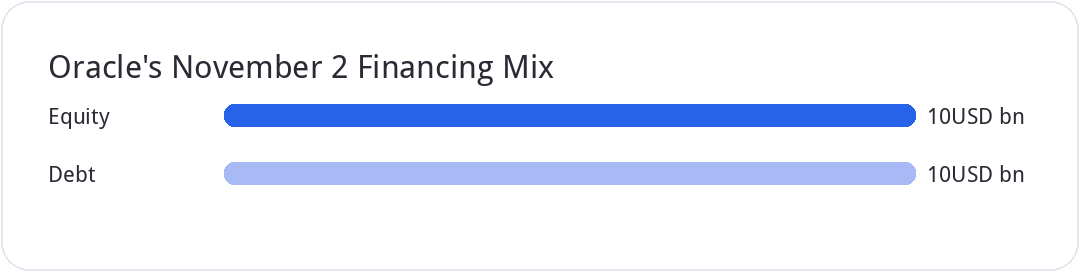
ORCL is now the clearest example of how quickly the AI capital-spending debate has shifted from demand to funding. At its October 28 investor day, Oracle said that incremental market funding for its fiscal 2027–2030 investment cycle would be capped at $20 billion, excluding refinancing. Management expected an even split between equity and gross debt.
Five days later, on November 2, Oracle launched $10 billion of common stock and $10 billion of bonds. Later that evening, it priced approximately 86.2 million shares at $116 each, alongside five bond tranches maturing from 2029 to 2046, with coupons ranging from 7% to 8.65%. Closing is expected on November 4.
The distinction matters. Oracle did not exceed the announced cap. It effectively used the entire planned allowance almost immediately. Investors now have less room to assume the company can spread its external funding across several years. The equity leg dilutes per-share ownership, while the debt leg adds fixed obligations before the projects have fully matured.
Oracle shares fell roughly 8.8% on November 2. The stock reaction is consistent with concerns about financing pace, debt burden and future cash generation, although a single headline cannot fully explain a stock's move. Oracle is targeting positive free cash flow only in the second half of fiscal 2028, followed by at least $30 billion in fiscal 2029. The spending is immediate; the cash conversion remains a forecast.
Oracle's February 1 funding plan had anticipated one early-year bond sale and no further bonds during calendar 2026. That was an expectation, not a legally binding prohibition. The more useful question is whether customer prepayments, cloud utilization, revenue recognition and credit spreads ultimately support the investment cycle.
Apple Shows the Value of Cash Already Coming In
AAPL provides the contrast. Apple reported fiscal fourth-quarter revenue of $114.48 billion, up about 12% year over year, and diluted EPS of $2.10, up roughly 14%. Both topped consensus expectations. iPhone sales reached about $57.58 billion, Mac revenue about $10.79 billion, and Services set a record at $31.57 billion. Yet Services growth slowed to roughly 9.8%, a reminder that even excellent franchises face growth-rate scrutiny.
Headline earnings also benefited from a one-off factor. Apple reported a 47.9% gross margin, with tariff refunds contributing about one percentage point. The same refunds added approximately five cents to EPS. Removing only that disclosed benefit produces a simple $2.05 comparison point, not an official adjusted EPS measure. Investors should not project a policy-related refund forward as recurring operating profit.
Greater China sales missed some analyst estimates. Management also flagged memory-cost pressure on holiday-quarter gross margins. Still, Apple generated about $28 billion of operating cash flow during the quarter and returned about $28 billion to shareholders. That cash generation gives shareholders a very different risk profile from an infrastructure company relying on a fresh mix of stock issuance and borrowing.
The next test is relative resilience. If profitable cash-generators hold up while financing-dependent infrastructure names keep sliding, the market may be pricing capital intensity rather than abandoning technology. If selling spreads to Apple's cash-flow peers as well, the adjustment is likely becoming a broader multiple reset.
Marvell and Lumentum Offer Industrial Logic but Complicated Equity Math
MRVL agreed to acquire LITE in an all-stock deal. Every Lumentum share will be exchanged for 4.5 Marvell shares. The companies described an implied enterprise value of about $115 billion, using unaffected October 28 closing prices. Existing Marvell shareholders would own about 67% of the combined business and Lumentum holders about 33%. Closing is expected in the first half of 2028, pending shareholder and regulatory approval.
The operating rationale is credible. Marvell brings custom silicon, switches and electrical interconnects. Lumentum brings lasers, optical modules and optical networking capabilities. Larger AI clusters require faster and more power-efficient movement of data. Management believes the combined platform could deliver more than $1 billion in annual run-rate cost synergies, but those remain projected savings, not current earnings.
Equity investors have to price a different set of risks. The fixed share-exchange ratio links Lumentum's deal value to Marvell's share price. Integration expenses, dilution, execution, regulatory timing and a lengthy closing window also matter. Both stocks came under selling pressure after the announcement. Strategic fit does not guarantee an attractive entry point.
Look for improving orders and margins in future releases, stabilization versus semiconductor benchmarks and credible progress toward closing. A compelling AI connectivity narrative is not enough on its own.
Seasonality Will Not Pay the Financing Bill
November through January has often been a favourable stretch for US equities, but historical seasonality is a tendency, not a guarantee. The specific challenge in this cycle is that expensive AI infrastructure must secure land, power, debt and equity long before every customer contract turns into usable cash. Lower rates can help valuations; they cannot automatically close each project's funding gap.
There are three reasonable paths. In the bullish case, Oracle's financing is absorbed, credit pressure eases, customer revenue converts to cash, and the Nasdaq 100 holds above 28,000 before rebuilding a sustained advance. In the middle case, the equal-weight market remains resilient while mega-cap technology trades sideways under funding and valuation pressure. In the bearish case, widening credit spreads coincide with deterioration in equal-weight breadth and a more general equity drawdown.
For portfolios already concentrated in AI or semiconductors, review exposure and near-term catalysts before adding to a rebound. Protective puts or collars may limit defined downside at a premium or with an upside cap. If protection is too expensive, trimming risk can be simpler. The key question has moved beyond whether AI demand exists. It is when that demand can deliver cash flows large enough to fund the buildout.