Tech hardware was sold. Industrials were bought.

US Stocks · Options · News · Views
Bonds were shut. The style did not change.
Monday was Columbus Day. The bond market was closed. Stocks stayed open, and the four main indexes traded on light volume. The Dow closed at 51,850.55, up 0.38%. The S&P 500 closed at 7,807.24, down 0.06%. The Nasdaq composite closed at 27,245.90, down 0.44%. The Dow was the only one up. The Nasdaq led the decline. Light volume came from stocks trading without the bond market, not from a finished direction.
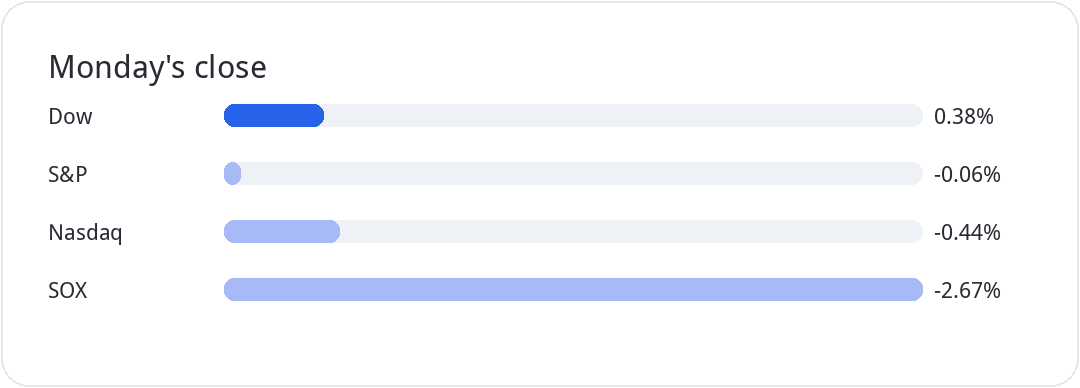
The Philadelphia semiconductor index was the weak spot: 28 members fell and only 2 rose. Inside the S&P 500, 321 stocks rose and 179 fell. Eight of the eleven sectors rose and three fell. Two of the laggards were the tech-heavy groups. Last week's style is still in place. Non-tech is doing the better work. Tech hardware is paying it back. A flat index does not show a flip in risk appetite. The groups do.
What this earnings week actually checks
Wednesday brings the September CPI. Thursday brings the PPI. Those are the last inflation prints before the Federal Reserve meeting on October 28. Thursday also has retail sales. Friday has industrial production. Third-quarter earnings open this week with the large banks, then ASML and TSMC. The banks speak to credit. ASML and TSMC speak to whether AI capital spending is still being raised. Do not rewrite the memory and semiconductor map off one light-volume session before those reports.
Memory is a margin question, not a shipment question
The memory ETF fell more than four points, then dropped about another three after the close. The trigger was CXMT saying its next memory-cell architecture had made real progress. Samsung and SK Hynix are working on the same kind of design. Samsung has put its sub-10-nanometer process target around 2028. CXMT is about 9.5% to 10% of global DRAM revenue, fourth behind Samsung, SK Hynix, and Micron.
This industry prices off capacity, and the swings are larger than in the rest of semiconductors. One more competitor hits gross margin first. The idea that margins peak in 2028 can get pulled forward by expectations. Anyone still in the group should watch industry news and memory commodity prices, not just the forward P/E.
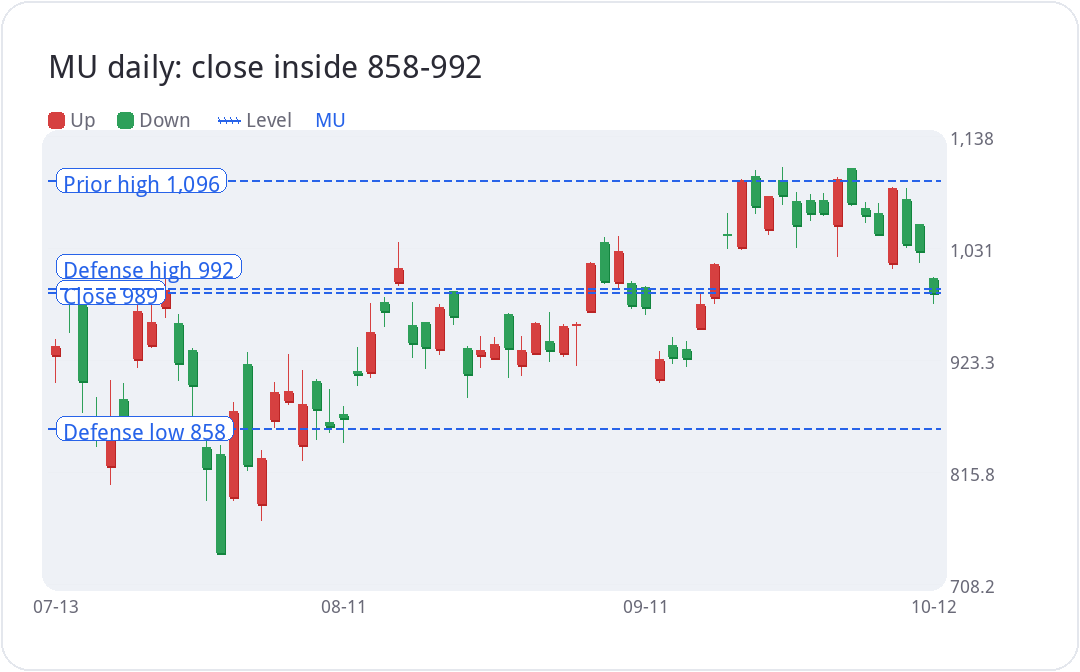
MU never got far after clearing 1,096. It fell back into the defense zone from 858 to 992. A break of that zone leaves thin support and a clearer downtrend. The close was 989.04, down 3.88%, already inside the zone. 858 is still some distance away. If institutions buy the zone in size, it is still a floor. If the bid looks strong and the zone still gives way, they do not want the margin-cut risk. Then 858 is an exit, not an add.
SNDK has to defend 1,354. If 1,354 to 1,463 gives way, the next busy trading area is much farther down. The close was 1,487.33, down 5.97%, still above 1,354, with one strong support already lost. NAND and DRAM are not the same line. They were sold in one basket. The deeper NAND print does not end the memory cycle.
The forward P/E looks low because next year's earnings assume gross margins still above 70%. In a normal year, this industry's 10- to 15-year average margin is closer to 55%. That is about 20 points. If the margin is revised down, earnings are revised down with it, and a cheap forward multiple gets expensive on its own. There is no target multiple here for Micron. The earnings number goes stale in three days. The levels that can be followed are 858, 992, and 1,096.
Meta lifted the price with another new product
META closed at 742.96, up 3.38%, on heavier volume. The broad tape was light. Meta's own tape was not. That is a headline, not the index dragging it. The product is Muse Wonder. Mark Zuckerberg framed it as a step toward personal superintelligence for everyone. Not everyone can use it. Inside Muse it is paid: 20 dollars a month, or 100. The zone that matters is 690 to 730. Once 730 broke, the view was new highs. Last week's pullback was a repair. A repaired base can travel more steadily. If the name is still a long, that pullback was the add for anyone light. Monday does not change the view: after the break, new highs, walked up rather than finished in a day. Missing the move before the start is not a reason to fill the position at the top of this candle. The resilience is the pattern. When the business softens, the company finds another product and the price gets lifted again. The wait is long. A long wait is not a case for a full position on the launch day.
Microsoft is grinding out new highs
MSFT closed at 541.15, up 1.14%. Friday's close was already a record. Monday extended it. Weekly and daily charts are close to overbought and not there yet. This kind of grind does not last. 540, 550, and 560 can be walked, then a volume pullback, then a base. After the breaks of 514 and 534, a light add is enough if the position is small. Do not put full size on the launch. The higher-conviction add is the pullback that packs the shares. No stock rises in a straight line. The point missed today can be given back on the next dip. What matters is a healthy advance, earnings that keep improving, and a cost basis in a steadier zone.
Hedge funds sold tech hardware and bought industrials
Hedge-fund exposure was still low last week. Sectors were mixed. At the single-stock level it was a third straight week of net selling, mostly from new shorts. Short positions are nearly twice the long positions. Information technology was the most sold sector. Inside it, hardware and semiconductors were sold the hardest. Software was bought the most. That is the IGV group.
Net long exposure to the Big Seven is at a record. Those seven are Microsoft, Google, Meta, Amazon, Tesla, and Nvidia. Broadcom is not in the set. They outperformed, which matches the exposure. A record net long is crowding, not safety. Crowded megacaps plus new shorts in hardware split tech in two: software bought, semiconductors sold. Monday's prices already show that split.
Industrials took the largest buy. After five straight weeks of selling U.S. industrials, hedge funds were net buyers at the fastest pace since early January, about 1.8 standard deviations. Two standard deviations is extreme. 1.8 is already large. Almost all of it was new longs, not short covering. The subgroups were aerospace and defense, construction and engineering, airlines, and industrial conglomerates.
Where industrials and staples actually sit
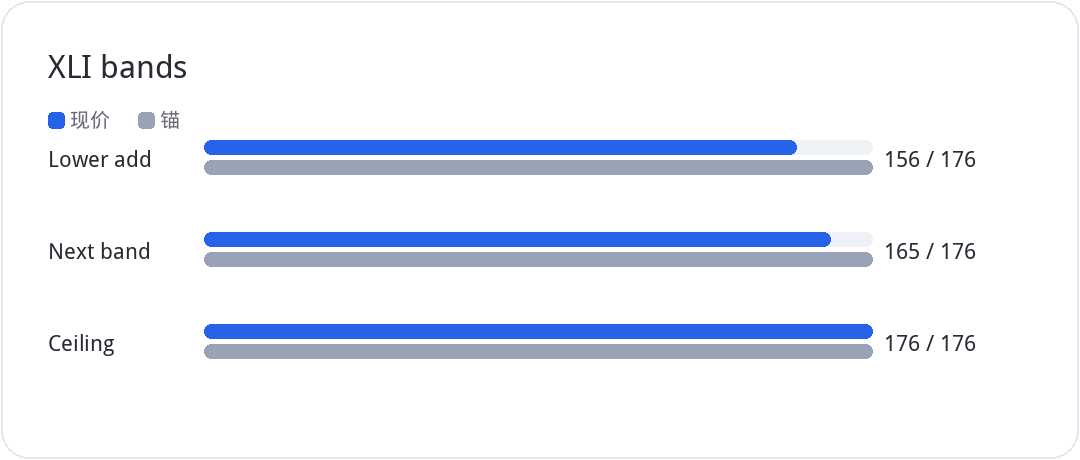
XLI has one strong ceiling left, 172 to 176. A break through that band leaves little supply overhead. Spot is the aggressive entry. The next band, 162 to 165, is also an entry. If 162 to 165 fails, do not catch the knife. Wait for under 156. Three separate pieces are there for room to be wrong, not for buying the whole position at once. The range has been sideways since September, about a month. A break of 176 is what gives individual industrial stocks room to start. There is still a medium ceiling above. The direction gets clearer once the range ends.
XLP is building momentum. 84.8 is not far. A break would end this low. That does not mean the price can never fall again. It means the recent low near 80 may not be revisited. Lows can lift toward 82 or 83 while highs lift with them. That is a spiral, and that is when the trend has changed enough for money to chase.
NVDA is back at its first medium support. There is nothing new to add. AMD still has 540 to 562 well overhead. This stretch is profit-taking after a large run, and it should be allowed. ASML and TSMC wait for this week's reports. A light-volume day is the wrong place to change those views.
The bond market is back tomorrow, and volume can reconnect. Monday's light tape stays with Columbus Day. The style did not flip because volume was light. Tech hardware is being sold. Industrials and software are being bought. Memory is about whether 858 to 992 holds. Industrials are about whether 172 to 176 breaks. Staples are about 84.8. Those three matter more than the S&P sitting on 7,800.