[Finance Weekly] Brent Crude Surges Past $116 as 10-Year Treasury Yield Returns to 5% Pressuring US Equities

US Stocks · Options · News · Views
S&P 500 Rally Halts at the 5% Treasury Yield Barrier Ending Upward Momentum
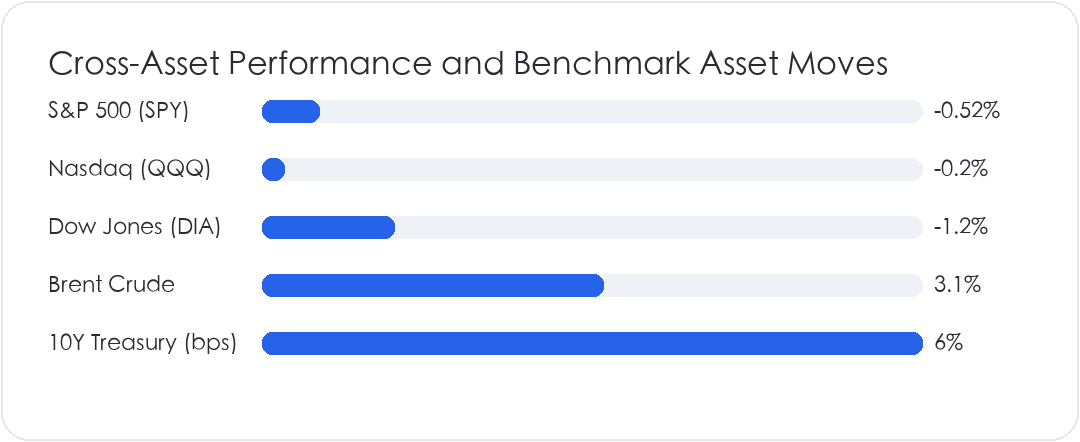
According to market closing data from Bloomberg on October 23, upward momentum in US equities decisively paused over the past week. The S&P 500 dropped 0.52% to close at 7,623.68, snapping its multi-week streak of record highs. The tech-heavy Nasdaq Composite demonstrated relative defensiveness, slipping 0.20% to close at 25,955.34; conversely, cyclical and value blue chips acutely sensitive to energy inflation and borrowing costs bore the brunt of the selloff, with the Dow Jones Industrial Average tumbling 652 points, down 1.20% to 52,215.16.
Across benchmark risk-free assets, the 10-year US Treasury yield surged in late Friday trade to test the critical 5.00% threshold. Auditing earlier macro models: while markets previously expected corporate earnings resilience to dilute valuation risks, the benchmark yield establishing footing at 5.00% has drastically curbed institutional risk appetite. Compared to 2024 when loose financial conditions dominated sentiment, global capital markets now operate under an unambiguous higher-for-longer regime with zero margin for cheap credit.
Oil Spike Triggers Secondary Inflation Shock as 5% Risk-Free Rate Resets Equity Valuations
The transmission mechanism driving long-end Treasury yields higher and compressing equity multiples centers on input-driven energy inflation colliding with restrictive policy expectations. Data released by the US Energy Information Administration on October 23 confirmed that international benchmark Brent crude surged over 3% to top $116 per barrel, reaching its highest level in four years amid escalating Middle East tensions. Surging crude prices immediately amplified freight and industrial input costs, reigniting aggressive portfolio hedging against secondary inflation waves.
Beneath commodity volatility lies structural repricing of the neutral policy rate. Following a 25-basis-point rate hike at its September meeting, the Federal Reserve maintains the target federal funds rate range at 3.75% to 4.0%. According to CME FedWatch futures pricing, while markets assign an 80% probability to a pause at the upcoming October FOMC meeting, persistent $116 oil has driven the probability of an additional 25-basis-point hike in December above 60%. With the 10-year Treasury yield trading at 5.00%, the US equity risk premium (ERP) has compressed to historical lows. The S&P 500's elevated forward earnings multiple faces intense gravitational drag, leaving little room for execution missteps.
Tech Mega-Cap Earnings Collide with the Federal Reserve October FOMC Decision
Wall Street confronts its most consequential macro crossroads of the second half, where monetary policy decisions intersect directly with Big Tech earnings reports. On monetary policy, the Federal Reserve convenes its two-day FOMC meeting on October 27–28, releasing its rate decision Wednesday afternoon followed by Chair Jerome Powell's press conference. Market focus centers on the Fed's characterization of $116 oil inflation and whether forward guidance solidifies a December hike bias.
In corporate earnings, five mega-cap tech giants accounting for significant index weighting report third-quarter results. Alphabet (GOOGL) leads after the bell Tuesday; Microsoft (MSFT) and Meta Platforms (META) follow Wednesday, where scrutiny will center on whether dozens of billions in AI CapEx translate into tangible enterprise monetization; Apple (AAPL) and Amazon (AMZN) report Thursday. Concurrently, US Q3 GDP preliminary estimates arrive Wednesday, September Core PCE inflation on Thursday, and the October jobs report on Friday. In an ultra-dense catalyst window, any fundamental miss will be severely penalized by 5.00% benchmark discount rates.
Confronting the 5% Yield Wall and Super Catalysts: 7,580 Emerges as Key Tactical Pivot
Under the macro headwind of a 10-year Treasury yield anchored at 5.00%, the critical market test is not merely whether Big Tech beats consensus estimates, but where institutional tolerance for ballooning AI capital expenditures reaches its limit. When risk-free paper guarantees an annualized 5.00% return, equity investors exhibit extreme sensitivity to free cash flow dilution. If executive leadership teams at Microsoft, Alphabet, and Meta further escalate 2027 CapEx budgets without commensurate revenue acceleration, multiple compression will spill across the broader equity market.
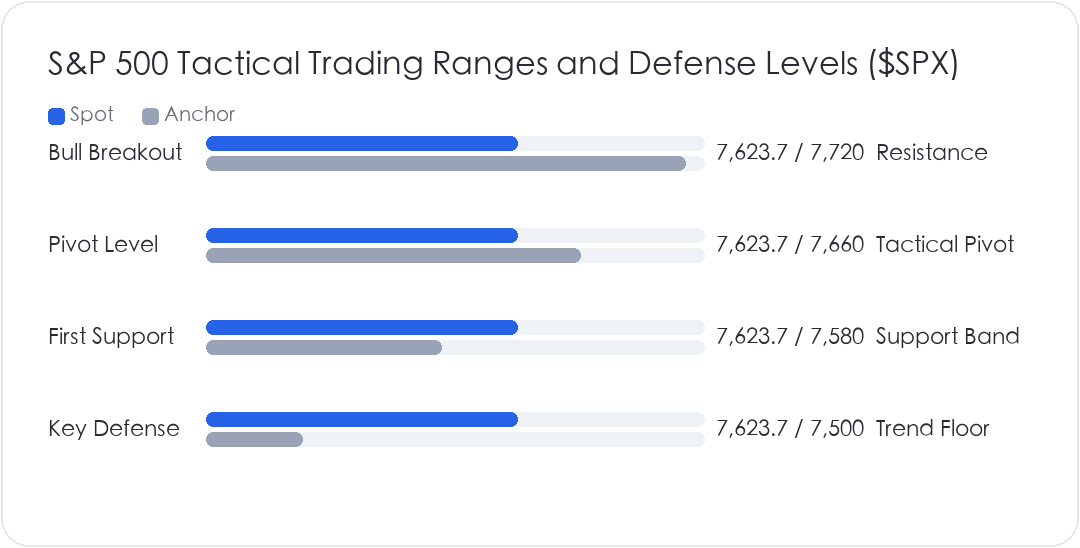
On the index charts, the S&P 500 establishes its primary tactical inflection line at 7,580. As long as the index maintains 7,580 on a closing basis, equities can sustain range-bound consolidation while absorbing elevated interest rates. However, a decisive breach triggered by earnings disappointments or further crude escalation will activate systematic trend-following sell stops, accelerating a test of the 7,500 round-number trend defense. Heading into major policy and earnings catalysts, prudent portfolio discipline demands resisting momentum chases and maintaining neutral positioning until macro volatility clears.