AI Positioning Cools; $486 Is the Next Test for SOXX

US Stocks · Options · News · Views
Indexes rebounded, semiconductors did not
U.S. stocks reversed early losses on October 15. The S&P 500 rose 0.3%, the Dow gained 1.1%, the Nasdaq added 0.1%, and the Russell 2000 advanced 1.4%. The rebound was broad enough to lift large and small caps, but semiconductors lagged. That split looks more like rotation and risk reduction than a market-wide liquidation.
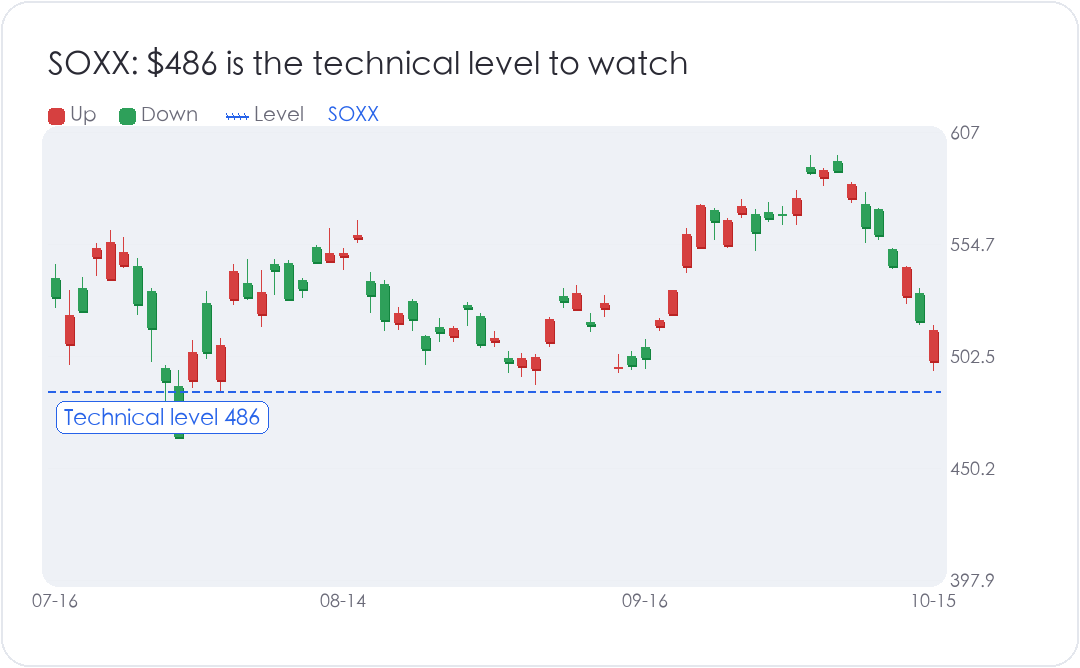
SOXX fell 4.5% on Wednesday. On Thursday it touched $495.79 intraday, then recovered much of the drop and finished down 0.9%. Buyers stepped in near the lows, but a single reversal does not establish a bottom. Price, volume, and breadth need to confirm that the selling pressure has eased.
Net buying returning to zero is not a full liquidation
A Goldman Sachs Prime Services flow monitor was described as showing five straight sessions of net selling in global AI stocks from October 8 through 14. That selling erased the cumulative net buying recorded since early 2025. The distinction matters: a net-flow series returning to zero does not mean every fund liquidated every AI holding, and it says nothing by itself about companies canceling projects.
Flows are evidence that risk appetite is cooling, not a substitute for orders, earnings, or cash generation. Synchronized selling of short-term positions can overshoot. And slower growth in hyperscaler CapEx is different from a cut in absolute spending. The demand test is whether cloud growth, chip orders, and the conversion of infrastructure spending into revenue and cash hold up—and whether companies lower current or next-year budgets.
A pullback becomes a cycle risk when estimates turn
Positioning and valuation can reset before earnings forecasts. A stronger warning would be a wider set of companies cutting revenue or profit expectations, cloud providers reducing absolute spending, and orders converting into cash more slowly. If those changes spread across semiconductor and broad-market estimates, the risk of a cycle turn would rise.
The S&P 500 and Russell 2000 rallied on October 15 while semiconductors remained lower. Pressure was still concentrated in technology and chips; it had not spread into a synchronized decline across sectors. The rebound also does not undo Wednesday’s sharp drop. Earnings revisions and market breadth need to improve together before the recovery looks durable.
$486 is the short-term technical pivot
The $486 level on SOXX is a technical reference, not a verdict on the industry. Thursday’s $495.79 low held above it. A closing break below $486, followed by a failed reclaim, would weaken the short-term setup. Swing traders should avoid chasing and wait for support and volume to stabilize.
Long-term positions require a company-by-company review of earnings quality, valuation, and funding needs. A stock priced for sustained high growth is more exposed to estimate cuts. One with firmer orders, cash generation, and more valuation room has a different risk profile. The ETF approaching a support level is not, on its own, a reason to add.
Valuation sets the downside for individual stocks
The risks are not uniform across semiconductors. Nvidia and AMD both have AI exposure, but their growth rates, gross margins, earnings forecasts, and valuations differ. When investors cut risk, a stock that needs very high growth to justify its multiple may be more vulnerable to estimate revisions. A company with more room in its valuation may hold up better.
Compare both companies on the same fiscal year and earnings basis. Then stress-test orders, gross margins, and EPS estimates. For example, ask how much valuation room remains if expected EPS falls 20%. That is a scenario, not a target price; it shows whether the entry price can absorb a forecast miss. A sector view cannot replace that work on each stock.
Hot inflation still constrains the rebound
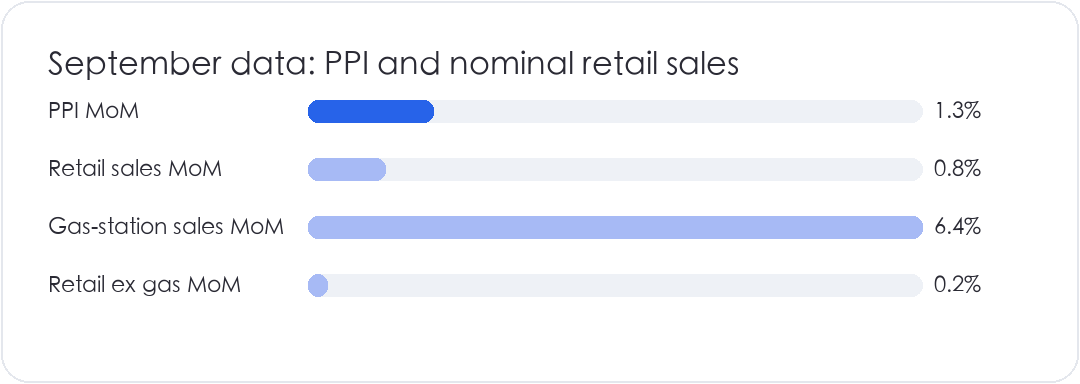
September final-demand PPI rose 1.3% month over month and 6.3% year over year. Goods prices advanced 2.6%; energy prices jumped 10.8%, accounting for more than 80% of the broad increase in goods prices. That upstream pressure makes near-term rate relief harder to assume. Higher discount rates weigh more heavily on richly valued technology, while financing costs also affect data-center returns.
September retail sales rose 0.8%, but the Census figures are not adjusted for price changes. Gas-station sales jumped 6.4%, while sales excluding gasoline rose 0.2%. The headline therefore does not establish a sharp acceleration in real demand. Initial claims were 199,000 for the week ended October 10; the four-week average was 198,500. The labor market has not weakened quickly.
Demand has not collapsed, but inflation makes rate cuts harder to count on. If price pressure eases and AI orders and earnings estimates hold, Thursday’s reversal could become a recovery. If inflation stays hot, yields rise, and cloud providers cut absolute spending enough to trigger EPS downgrades, semiconductors and high-multiple technology could face another round of compression.
Watch earnings revisions and whether SOXX holds $486 on a closing basis. A break would add to price risk; it would not, by itself, prove that the industry cycle has ended. One day of gains is not an all-clear.