Inflation Reaccelerates as AI Infrastructure Financing Comes Under Scrutiny

US Stocks · Options · News · Views
Market view: inflation and funding risks converge
All four major U.S. indexes finished lower on October 14. The Nasdaq and Russell 2000 each fell about 1.9%, the S&P 500 lost roughly 1.1%, and the Dow slipped 0.1%. The Philadelphia Semiconductor Index dropped around 4%, with 29 components down and one higher. Meta fell nearly 3%, so large-cap technology did not provide a full shelter. Inflation, bank earnings, and questions about AI data-center financing all weighed on sentiment; no single headline explains the full move, so confidence in a one-factor attribution is only moderate.
September headline CPI rose 0.6% month over month and 3.7% year over year. Core CPI increased 0.3% month over month and 2.6% year over year. Gasoline jumped 9.1% and accounted for more than half of the monthly headline increase. Recreation, used cars, medical care, and airfares also rose, while communication services edged lower. Inflation is cooling unevenly, which keeps pressure on rate-sensitive valuations.
After the report, market pricing put the odds of an October rate hike near 33%, though the base case remained no change; the next hike was still priced for December. Bank of America reported earnings of $0.91 per share after a $1.2 billion regulatory settlement charge tied to anti-money-laundering controls. Adjusted EPS was $1.08. Fixed-income trading revenue fell 17% year over year, while equity trading revenue rose 11%, so weakness was not uniform across the bank. The settlement and softer parts of the report still added pressure on financials. The Russell 2000's heavier exposure to smaller financial firms left it more vulnerable; it had pulled back about 10% from its recent high, entering correction territory.
ASML: strong results, but no quantified 2027 outlook
ASML posted third-quarter revenue of €11.662 billion and net income of €4.960 billion, both above expectations. It raised its full-year 2026 sales outlook for the third time, to €44 billion–€45 billion. Management said planned supply for 2027 and 2028 would still fall short of customer demand. The company is examining additional capacity beyond its existing plan for roughly 30% growth and is also discussing potential price increases. It did not provide quantified 2027 revenue or profit guidance, making it hard for investors to translate strong demand into a specific earnings ramp.
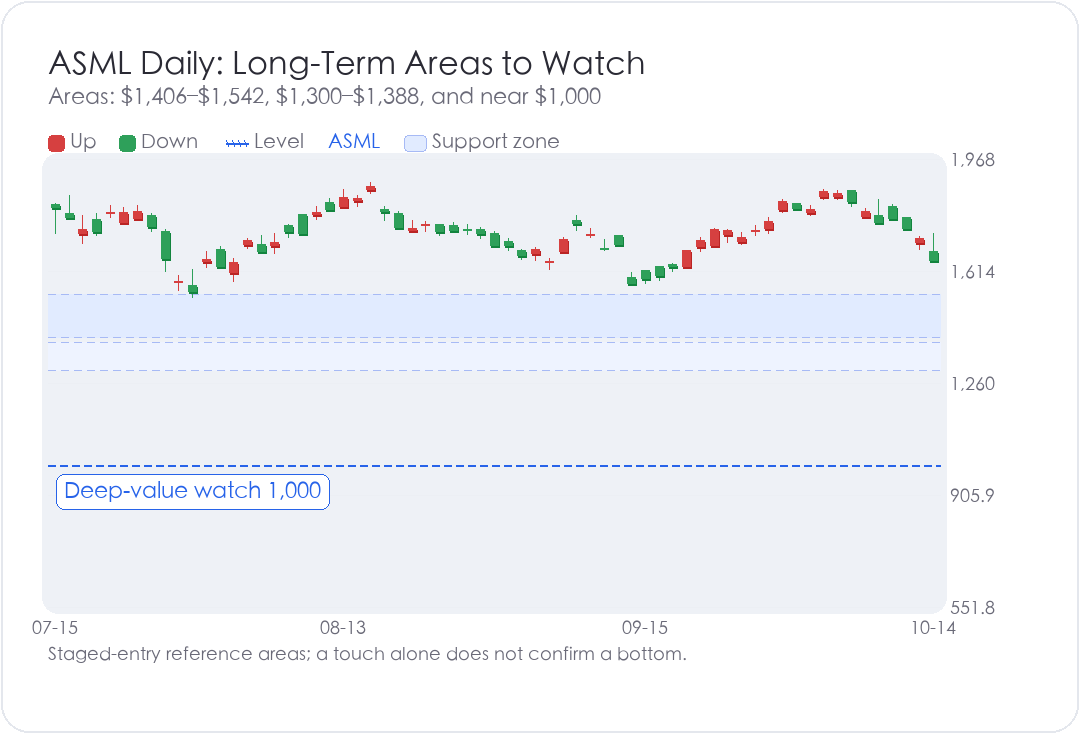
Forward valuation medians cited in the analysis were about $1,464 for 2026 and $1,929 for 2027. Those are scenario references, not near-term price targets. After ASML broke below $1,683, the stock moved into a wide $1,406–$1,884 range, leaving little clarity for a short-term swing trade. Longer-term buyers can watch three areas for staged entries: $1,406–$1,542, $1,300–$1,388, and around $1,000. None is an automatic buy zone; each still needs fundamental support and evidence that selling is stabilizing.
CoreWeave: compute demand does not guarantee cash conversion
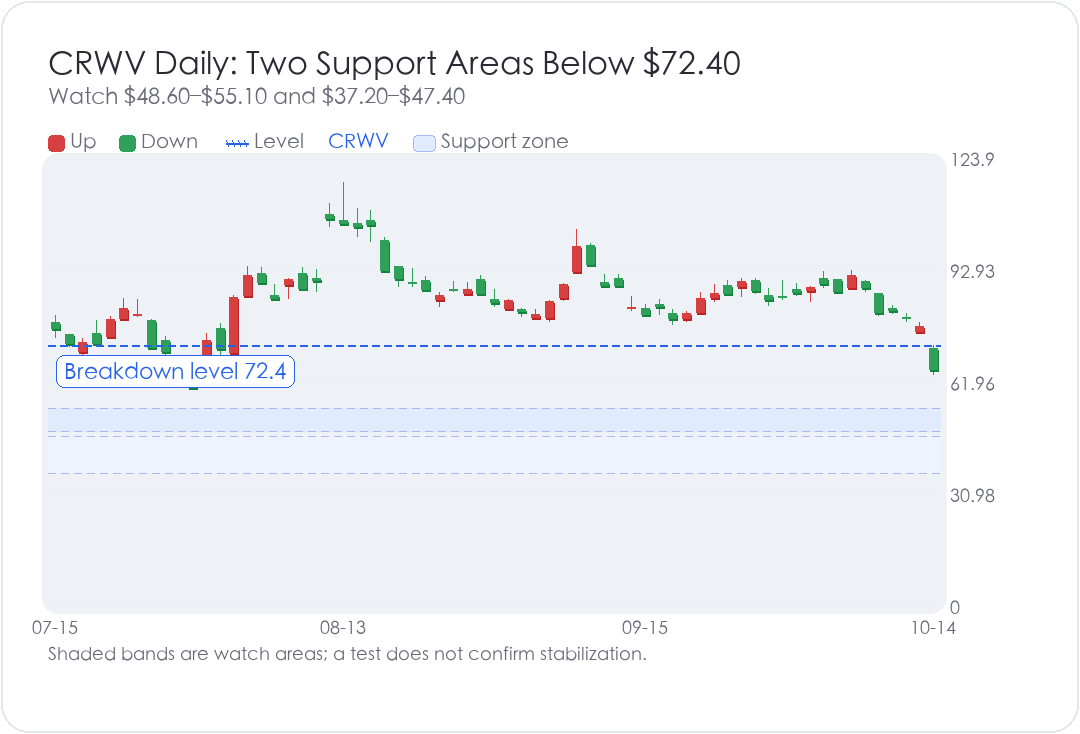
CoreWeave fell about 15% in one session, closing near $65.78. Its bonds yielded more than 15%, while credit-market pricing implied roughly a 63% chance of default over five years. Those are market risk signals, not a prediction that the company has defaulted or inevitably will. In the second quarter, net interest expense reached $640 million, up from $267 million a year earlier, and the net loss was $626 million versus $290 million. The interest burden is growing quickly.
Borrowing costs are around 9%, compared with roughly 1% on short-term investments; even a 4%–5% near-term return target would remain below the financing cost. Strong demand for compute does not mean a data center can be built and turned on quickly. Power, cooling, networking, equipment delivery, and permits all have to come together. Lenders are emphasizing cash collateral and have been reluctant to treat Nvidia GPUs as sufficient collateral. Permitting delays and local opposition can also extend construction schedules, allowing interest and depreciation costs to accumulate before revenue arrives.
CoreWeave is not necessarily on the verge of bankruptcy, but the break below $72.40 has damaged the chart and leaves overhead supply. The next areas to watch are $48.60–$55.10 and $37.20–$47.40. A durable recovery needs better financing access, revenue conversion, and operating cash flow. Oracle also faces heavy AI-infrastructure spending, but its traditional software business provides positive cash flow and a thicker cushion than a pure-play compute cloud.
Mega-cap tech and indexes: a pullback is not yet a broad breakdown
Large platforms have diversified revenue and can slow capital spending if AI infrastructure returns disappoint. That makes them more resilient than highly leveraged compute clouds, but rates and capex returns still matter. Microsoft has stalled and pulled back. The $490–$514 area is a key breakout retest zone, while the longer-term view still points above $600 if earnings and support hold. Google and Amazon have mainly given back part of the past few sessions' gains and remain inside their prior ranges. Meta had run up quickly; its structure remains constructive as long as $656 holds.
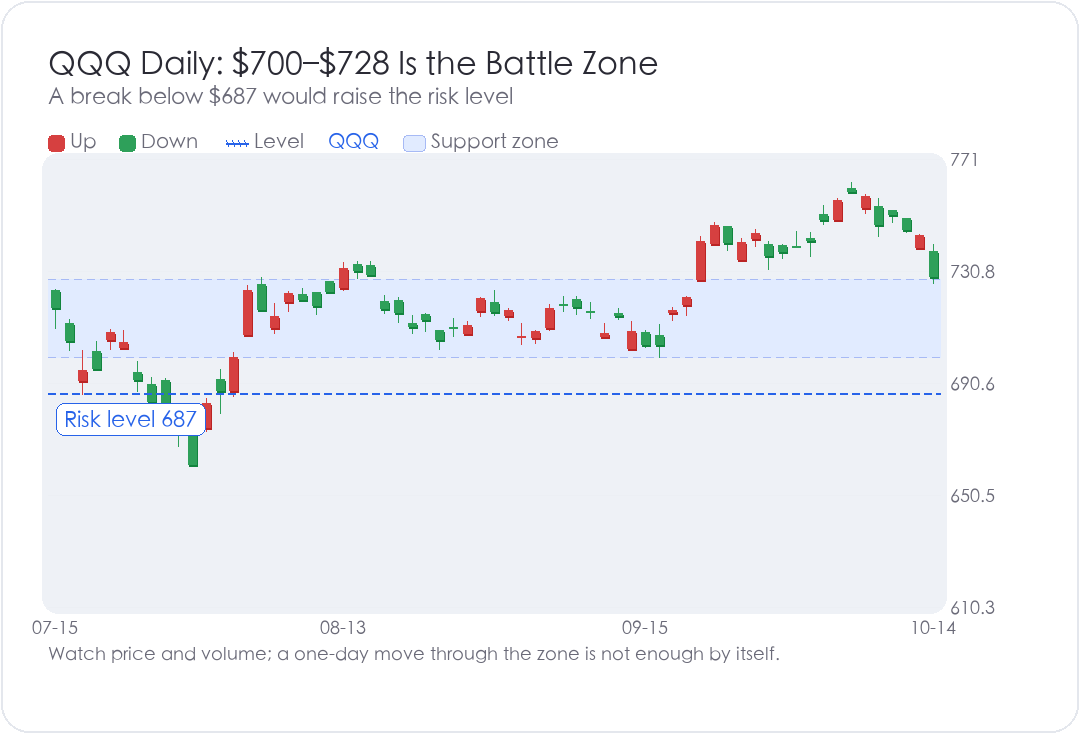
The S&P 500 pulled back to around 767, giving back much of the prior week's low-volume grind. For QQQ, the main battle zone is $700–$728; a break below $687 would materially raise risk. The VIX is around 16, still below reference warning levels of 18, 20, and 22. Options markets are not paying up for a near-term crash, so the two-day selloff looks more like a high-volatility shakeout than confirmation of a systemic decline. That index-level resilience does not erase the risk in individual names that have already broken support.
Trading plan: let price and volume decide at 486 on SOX
The Philadelphia Semiconductor Index is at an important decision area, with 486 as the next dividing line, about 6% below the October 14 close. If the index reaches that area and finds clear support on heavy volume, a small position after confirmation may be reasonable. If it breaks below 486 on heavy volume without buyers stepping in, reduce risk and use stops; do not catch a falling knife because the decline looks large. Strong ASML orders, CoreWeave's credit stress, and the cash-generation capacity of mega-cap technology can coexist. They reflect different conversion speeds across the same AI investment chain. The key evidence now is whether financing reopens, projects reach operation, and revenue turns into cash—not demand headlines alone.