A 29,000-Job Print Still Left QQQ at a Record

US Stocks · Options · News · Views
The Nasdaq 100 closed at a record, and the long end did not cooperate
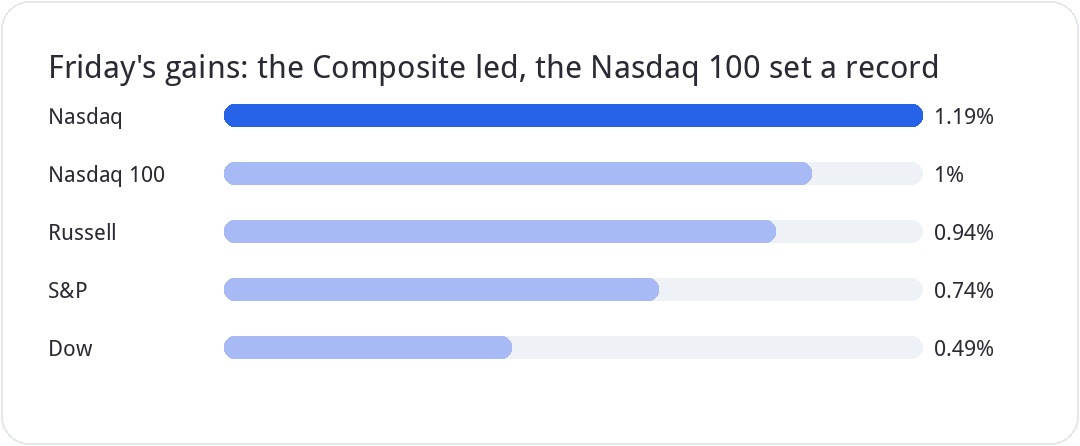
All four major indexes rose on Friday. The Dow closed at 51,182.11, up 0.49%. The S&P 500 closed at 7,722.85, up 0.74%. The Russell 2000 rose 0.94%. The Nasdaq Composite closed at 27,190.86, up 1.19%. The Nasdaq 100 closed at 30,807.93, up 1.00%, a record close. QQQ traded around 749, also at a record. Roughly 300 S&P names finished higher and about 200 finished lower. Technology and consumer discretionary led. The Philadelphia semiconductor index broke out with SMH.
Bonds did not celebrate. The 10-year yield fell early and then reversed, finishing near 5.29%, above Thursday. Equities took the cooler hike odds. The bond market took the unfinished inflation and policy path. The high is real. The confirmation is not complete.
October is still a high-volatility month. The direction is up, and the range will be wide. It is not a straight line. Systematic trend funds are buyers in a rising or flat tape. They already sold through September. They do not come back to sell unless the drop is large.
Payrolls rose 29,000, and the October hike odds fell into the low teens
September payrolls rose by only 29,000. The consensus was 90,000. August was revised from 162,000 to 133,000. July and August together were revised down by another 60,000. The unemployment rate rose from 4.1% to 4.2%. Participation rose from 61.6% to 61.8%. Private payrolls added 46,000. Government payrolls fell 17,000. Average hourly earnings rose 0.1% on the month, versus 0.3% expected, and 3.0% on the year, versus 3.2%.
The labor market is not as strong as the prior print implied. Before the report, an October hike was priced around 22%. After it, rate futures fell to about 13%. If August had first printed 133,000 instead of 162,000, the September hike itself might not have happened. Revisions this large can rewrite a meeting. The first print is a draft.
Tesla beat on deliveries, and the chart is still 331 to 415
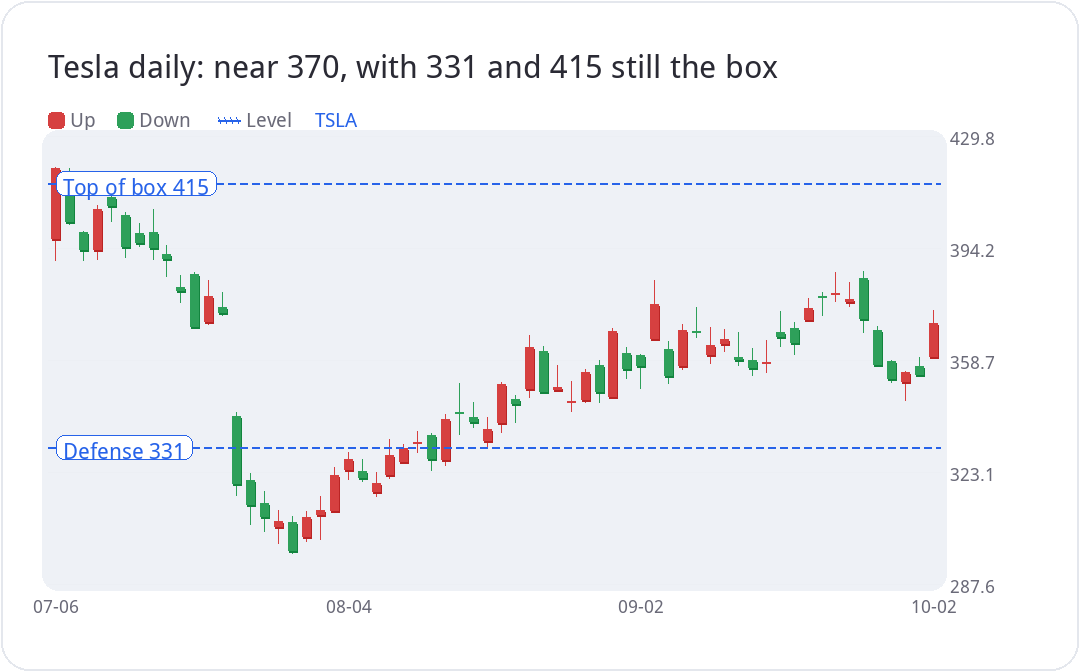
TSLA delivered 486,532 vehicles in the third quarter. The company-compiled sell-side consensus was 461,974, a beat of about 24,558 vehicles, or 5.3%. Model 3 and Model Y were 478,237 of the total. Production was 464,391, so deliveries ran ahead of builds. Year over year, deliveries are still down about 2%, from 497,099. Energy storage deployments were 13.7 gigawatt-hours, below the compiled 15.9. The cars beat. Storage did not. Earnings are after the close on October 21.
The price is still in the old box. The near stop is 331. The first overhead is 415. The top of the range is 465. The prior high was near 400. Wednesday printed a stabilization, and Friday rose more than 4% back toward 370. If 331 is a tight enough stop and 415 is enough room, it can be a swing. If it is not, wait. This is not a long-term entry. Without a clear of 415 to 465, a push can still be sold back to the bottom of the box. New highs are a conversation only after that clear.
Amazon wants $8 billion of chips off the balance sheet
The long-term view on AMZN has not changed. What changed is the balance-sheet design. The Financial Times reported that Amazon has spent recent weeks talking to investors about moving about $8 billion of Nvidia Grace Blackwell chips into a special-purpose vehicle. That vehicle would borrow to buy the chips and lease them back to Amazon. Amazon would not own the vehicle. It would offer at most a 10% equity stake. The chips are already installed in more than a dozen U.S. data centers. The talks are ongoing and can change.
The stated aim is a lighter balance sheet: move depreciation and debt off the books and protect the credit rating. What remains is rent, not the depreciation of this chip vintage.
That is the opposite of Nvidia's circular financing. Nvidia has funded customers, directly or indirectly, so those customers can turn around and buy Nvidia chips, which supports reported revenue. Amazon is trying to sell the asset while it still has value, and to run the cost as rent later. The historical parallels are mechanisms, not forecasts of the same ending. Cisco financed customers into equipment and then fell about 90% from the peak after the 2000 internet bust. Enron moved problems off the balance sheet and failed in 2001 because revenue could not cover what had been hidden. The structure can be legal. Disclosure is not concealment.
While industry revenue is still growing and the liquidity chain still holds, this is operating leverage: near-term depreciation swapped for future cash. If cash flow, or revenue across the AI complex, comes in below what is priced, the off-balance-sheet rent becomes a real constraint. A long-term hold in a high-quality name can stay in place. The condition is that the published balance sheet and the earnings still match. Heat is not the condition. Amazon is not the only company moving assets off the books. If the car is heading for the ditch, the story is not a reason to stay in it.
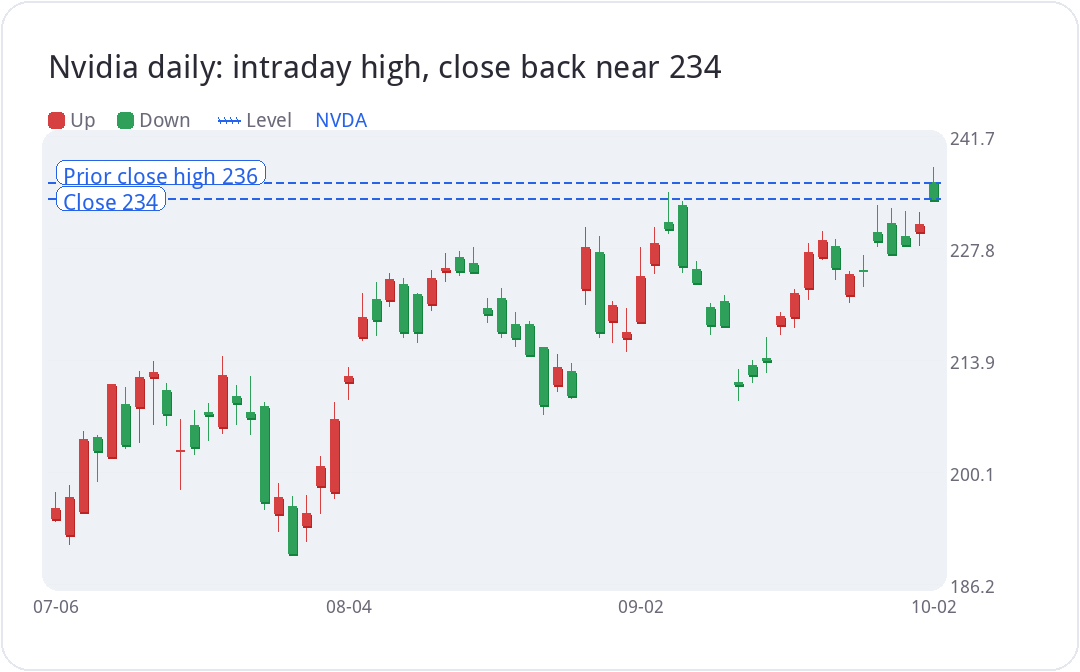
NVDA made a new intraday high on Friday, near 238, and closed back around 234. The close is not yet through the prior closing highs around 235 to 236. It is close. A gap up that fades but still finishes near the recent high is a neutral hold, not a strong top.
Semis broke out, and the divergences did not heal together
SOXX was a fraction short yesterday. Friday gapped open to 590 and completed the breakout, the same break SMH made. After a break, the path is a slow look at the prior high and then a new high: higher lows, higher highs, a spiral, not a straight line. A down day next does not cancel the break. It cancels the idea that the path is a one-day ramp.
The flaw is still there. SOXX still has a daily RSI bearish divergence. SMH repaired its divergence with Friday's rally, and the cost was an overbought reading. Repair the divergence, and the next job is often to repair the overbought condition. A pullback can still come. Friday's close is a recent high, so this candle is not evidence of a pullback top. Once the trend is higher lows, a pullback can be held. Chasing a few tenths of a point is not the trade.
AppLovin is at the next shelf, and a break points under 180
The August shelf on APP was 317 and 353. A break of 317 was the hedge. The stock never reclaimed 353. Rallies kept failing, and a fresh headline hit it again. Price is now in 252 to 297.
If that zone holds, it can be a staging low: base, then look for a bounce and for the fundamentals to improve. If it breaks, the chart opens an air pocket toward below 180. There is no point trimming again at 317. That trim is late. Friday showed some defense, but the close was a new low, so the stabilization is weak. If the position is still on and the earlier hedge was missed, the question is whether this shelf actually holds.
Three paths
Bullish: payrolls keep the October hike in the low teens, QQQ holds the record close around 749, and SOXX and SMH do not lose the breakout on the pullback. A spiral higher can be held. If the 10-year gives back 5.29%, the new high finally has a bond market that agrees.
Neutral: the index high is intact and the 10-year parks near 5.3%. TSLA stays inside 331 to 415. NVDA still cannot close through 236. The breakout is real, and it is not a straight-line chase.
Bearish: the 10-year holds above 5.3%, the SOXX divergence starts to matter, and APP closes through 252. If Amazon's chip sale moves from talks to a closed deal while AI revenue slows at the same time, the off-balance-sheet rent stops being an accounting choice.