The indexes recovered Thursday. The carriers did not

US Stocks · Options · News · Views
All four indexes rose, and the S&P did not clear Tuesday
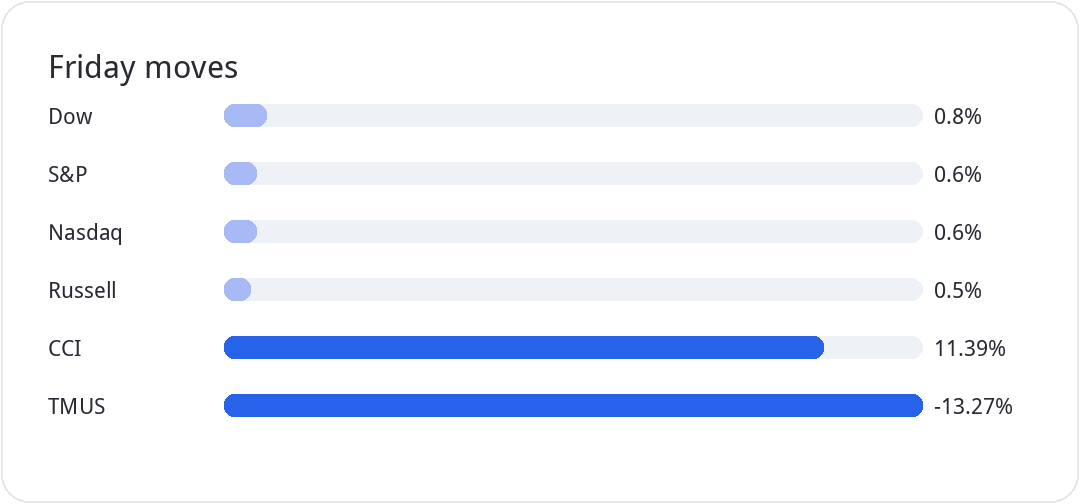
Friday finished higher across the four indexes. The S&P 500 gained 0.6% to 7,811.54, close to the record close set three days earlier, and did not take it out. The Dow gained 0.8% to 51,654.95. The Nasdaq composite gained 0.6% to 27,366.17. The Russell 2000 gained 0.5% to 2,806.98.
For the week the S&P 500 rose 1.2%, the Dow 0.9%, and the Nasdaq 0.6%. The Russell fell 0.9%. Thursday was the Nasdaq giving blood back to the rest of the tape. Friday took part of that down candle back at the index level. Green on the indexes is not the whole tape coming back. The move was in the carriers and the towers. The 10-year yield closed at 5.24% after swinging. Brent erased an early drop and finished slightly higher.
Starlink bought indoor spectrum. The carriers fell first
SpaceX agreed to buy a nationwide license portfolio from Grain Management, up to 14 megahertz of paired 800 MHz spectrum. The Wall Street Journal put the price at about 8 billion dollars in cash. SpaceX already holds higher-frequency 2 GHz licenses. The low band is meant to reach indoors and push Starlink toward mobile service. The news hit Thursday evening and traded on Friday.
TMUS closed at 148.58, down 22.73, or 13.27%. The prior close was 171.31. The session low was 147.90. Verizon and AT&T were sold with it. During the session Verizon was pacing its worst day since 2002, down about 7%, and AT&T was down about 10%. At the open the three carriers had shed about 39 billion dollars of market value, close to five times the price of the spectrum. SPCX was up only about 1% at midday.
What sold off is the competition, not subscribers who have already left. 800 MHz travels far and gets through walls. Owning the license is not the same as having the network built. FCC Chair Brendan Carr said more competition in spectrum is good for consumers, and that more than 100 billion dollars of spectrum is likely to come to market over the next two years. That is later supply, not Friday's earnings. Without new evidence of lost subscribers, 13% is not share already taken. SPCX up about 1% does not mean the market dismissed the deal either. The carriers lost several times what the licenses cost.
The tower rally is a tenant guess
CCI closed up 11.39% at 76.74. American Tower was up nearly 7% during the session. The story is that indoor low-band coverage could mean a satellite operator eventually rents sites, power, and backhaul. Crown Castle said on its second-quarter call that it would welcome satellite operators. There was no company announcement on Friday, and no new contract. Bernstein's point is that buying spectrum is not a commitment to build.
AT&T is about 28% of Crown Castle's site-rental revenue. If the carriers cut spending because of a new competitor, the towers' biggest customers get weaker too. Carriers down and towers up cannot both be finished facts. The 11% is a guess that got bought first. Without a lease, 76.74 is not confirmation. The carriers are trading competition. The towers are trading capital spending that has not shown up.
Semis leaked again on light volume. 550 is still intact
SOXX closed Friday at 560.26, down 0.54%. It opened at 570.65, high 570.94, low 557.29. Volume was about 3.91 million shares. Thursday's close was 563.28, down 3.35%, on about 10.36 million shares. On a day the indexes rose, the semiconductor fund did not reclaim. It just softened a little more, on much less volume.
The low at 557.29 is still above the 550 to 577 band from Thursday. A break of 550 only extends the chop down to 486. The view changes at 486, about 15% under the close. Friday was not a high-volume break, and it did not change Thursday's structure. While 550 holds, the extra half point is not an exit. Semiconductors lead again only with volume back through 577. A 0.6% Nasdaq gain does not do that job.