AMD Guides to $17 Billion, but Free Cash Flow Falls 64%

US Stocks · Options · News · Views
The Index Rose, but Breadth Still Failed to Confirm
US equities did not suffer a broad selloff on November 3. The S&P 500 rose 0.36% to 7,568.92, while the Nasdaq Composite gained 0.83% to 25,372.01. The Dow fell 0.38% to 51,786.72. Strength in NVIDIA and other mega-cap technology stocks helped lift the benchmarks even as more S&P 500 members declined than advanced. Calling it an across-the-board AI crash would misread the tape. Treating the index gain as an all-clear would be equally premature.
The September JOLTS report kept the rates debate alive. US job openings rose to 7.523 million from a revised 7.190 million in August. The openings rate increased from 4.3% to 4.5%, and the quits rate rose from 1.9% to 2.1%. Labour demand remains resilient enough to complicate assumptions about rapid monetary easing. Higher Treasury yields can still challenge expensive growth multiples.
For positioning, use the S&P 500's latest close near 7,569 as a reference point rather than a guaranteed floor. A rally led by a handful of large companies while underlying participation fades warrants caution. A more durable recovery would require better breadth alongside leadership.
AMD's Sales Outlook Is Stronger Than Its Cash Conversion
AMD reported third-quarter revenue of $13.377 billion, up 45% year over year. Data Center revenue jumped 97% to $8.546 billion, a powerful sign that demand for its EPYC CPUs and Instinct accelerators is being recognized in actual sales. Adjusted EPS was $2.09 and the non-GAAP gross margin was 56%. Management expects roughly $17 billion of fourth-quarter revenue, plus or minus 3%, implying about 66% annual growth at the midpoint. Its adjusted gross-margin outlook is 55%, down one percentage point from the third quarter.
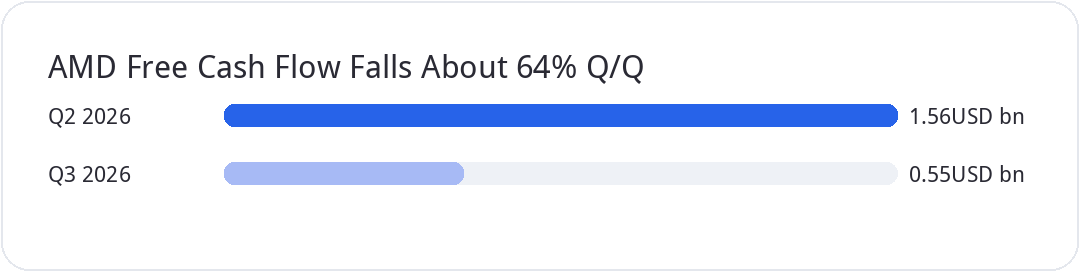
The tension lies in cash conversion. AMD generated $1.202 billion in operating cash flow during the third quarter, down from $2.366 billion in the second. Free cash flow dropped from $1.558 billion to $554 million, roughly a 64% sequential decline. Capital expenditure also fell, from $808 million to $648 million. Higher spending on property and equipment therefore does not explain the decline. Working capital deserves a closer look.
Inventory climbed 35% quarter over quarter, from $8.468 billion to $11.463 billion. Net accounts receivable rose 26%, from $7.281 billion to $9.209 billion. Both grew faster than total revenue, which rose 16% sequentially. The inventory build could reflect production ahead of major product deliveries, but it also raises questions about timing and cash efficiency. One quarter alone does not establish unsold inventory or an impending credit problem.
Total debt jumped from $3.226 billion to $7.079 billion, partly reflecting a $4.75 billion note offering completed in August. Yet AMD also held $15.776 billion in cash, equivalents and short-term investments. This is not a balance sheet that can fairly be described as already insolvent. The test is whether revenue growth starts releasing cash rather than absorbing more working capital.
AMD finished regular trading on November 3 at $483.90, up 3.65%. Following the earnings release, after-hours quotes were around $508. Those two trading sessions must not be blended. A sustained regular-hours hold of $500–$510 would provide a better short-term confirmation. A drop back below $480, particularly toward the $473 area, would weaken the rebound thesis. Goldman Sachs reiterated a $700 target, but a sell-side target is a scenario, not a guaranteed fair value.
Palantir's Revenue Surged, While New Booking Growth Slowed
PLTR reported third-quarter revenue of $2.313 billion, up 96% year over year and 20% sequentially. US commercial revenue jumped 148% to $984 million, exceeding US government revenue of $953 million for the first time. Adjusted EPS came in at $0.44, and adjusted free cash flow was $1.216 billion. This is a highly profitable company delivering extraordinary reported growth.
New contract metrics told a more restrained story. Total contract value signed in the quarter reached $2.918 billion, up just 6% year over year. US commercial TCV was $1.463 billion, up 11%. Revenue recognition and contract signing measure different things. Revenue reflects delivery under existing arrangements; TCV records the value of contracts executed in the period. Large deal timing can move quarterly bookings. Six percent TCV growth does not mean next quarter's revenue must grow only six percent.
The counterweight is US commercial remaining deal value of $6.517 billion, up 79% year over year. Revenue growth, quarterly signing volume and contracted backlog can move at different speeds. Rather than declaring an imminent growth collapse, watch whether new deal flow rebounds and remaining commitments convert into recognized sales while cash margins stay high.
Valuation remains the challenge. Even excellent results can fall short of expectations embedded in a premium stock. On November 3, PLTR traded as low as $165.25 but recovered above $169 and finished at $175.40, down about 1.65%. It would be incorrect to describe $169 as an already confirmed closing resistance level. A fresh break below $165 could bring the $151–$161 zone back into focus. Sustained trade above $175, supported by improving relative strength, would argue for stabilization.
Midterm Betting Odds Are Not Election Results
The November 3 US midterm elections created a separate source of uncertainty. At one point, prediction markets placed a near-99% probability on Democrats taking both chambers of Congress. Betting prices can move dramatically with a relatively small change in the flow of orders. They are not official calls or certified election results. By the time the latest reports were available, major outlets were reporting that Democrats had taken Senate control, while the final House result still required further counting.
A change in congressional control can reshape committee leadership, subpoenas, oversight hearings and budget negotiations. For technology companies, that may increase the scrutiny of data-centre expansion, energy consumption, infrastructure contracts and private financing. However, federal legislation and local permitting remain distinct processes. A betting-market spike does not prove that construction projects are about to be stopped nationwide.
If both chambers end up controlled by Democrats, the president still retains the constitutional veto. That makes sweeping legislation harder, even as investigations and disclosure requests could increase. Investors should track specific state approvals, utility agreements, hearings and corporate capital-expenditure guidance rather than treating a single election-night probability as a deterministic market catalyst.
A VIX Near 21 Makes Risk Controls More Important
The VIX ended November 3 around 20.83. This index reflects option-implied volatility over roughly 30 days; it does not predict tomorrow's market direction. Levels such as 18, 22 and 30 can help describe changes in sentiment, but none is a reliable mechanical buy or sell signal.
There are three paths from here. In a bull case, AMD delivers its $17 billion revenue outlook, free cash flow improves, Palantir's new bookings recover and election-related policy questions become clearer. In a base case, major companies keep reporting fast growth while inventory, collections and valuation fuel choppy trading. In a bear case, hyperscaler spending slows, inventory and receivables keep swelling and weakness spreads beyond a narrow group of expensive technology stocks.
For concentrated technology portfolios, check position sizing, the cash needed to meet any short-put assignments and the drawdown you can withstand over the next month. Protective puts and collars can reduce certain losses, but option premiums and upside caps matter. A strong AI demand narrative does not replace cash flow and earnings per share.