Meta Leaves 2027 CapEx Open, Keeping the AI Trade on Trial

US Stocks · Options · News · Views
The rebound does not mean AI leadership is back
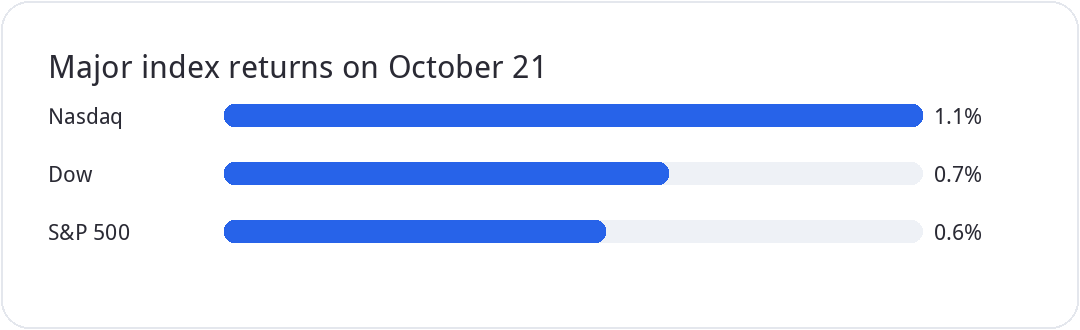
U.S. stocks advanced on Wednesday, October 21. The S&P 500 rose about 0.6%, the Nasdaq gained 1.1%, and the Dow added roughly 0.7%. The rebound eased near-term pressure, but one session does not prove that money has returned to mega-cap tech. The next test is whether earnings translate AI spending into durable revenue, margins, and cash flow.
LRCX: Record results still need order follow-through
Lam Research reported September-quarter revenue of $8.219 billion, up 22% sequentially. GAAP operating margin reached 40.0%, and diluted EPS was $2.19. For the December quarter, management guided to revenue of $8.60 billion, plus or minus $400 million, and GAAP diluted EPS of $2.33, plus or minus $0.15. The combination of stronger revenue, better margins, and higher guidance points to continued support for wafer-fabrication equipment demand.
The risk is extrapolating one strong quarter too far. Semiconductor-equipment valuations already reflect substantial AI-investment expectations. Watch customer capital spending, whether order growth broadens, and whether guidance keeps moving higher. If orders and revenue fail to match the bar, a pullback would not be surprising. Long-term exposure should be confirmed by orders and guidance, not added solely on the strength of one report.
META: Profit took a one-off hit, but 2027 CapEx is still a blank
Meta generated $64.601 billion of third-quarter revenue, up 26% year over year. Ad impressions rose 10% and the average price per ad increased 14%, although impression growth slowed from 14% a year earlier. Operating margin fell to 20% from 40%, including a roughly $9.89 billion legal-settlement charge. Excluding that charge, Meta reported about $22.88 billion of operating income and adjusted EPS of roughly $7.40. The GAAP decline alone does not establish that the core business has deteriorated, but rising costs and margin pressure remain relevant.
Meta narrowed its 2026 capital-expenditure outlook to $135 billion to $145 billion. It expects CapEx to increase further in 2027 and beyond, yet it did not provide a number. That leaves investors without the quantitative signal that matters most to the AI supply chain. Higher spending is not automatically bullish: the pace of investment, compute utilization, and monetization must exceed expectations. If spending growth proves modest or revenue conversion disappoints, chip suppliers will have a harder time defending premium valuations on narrative alone.
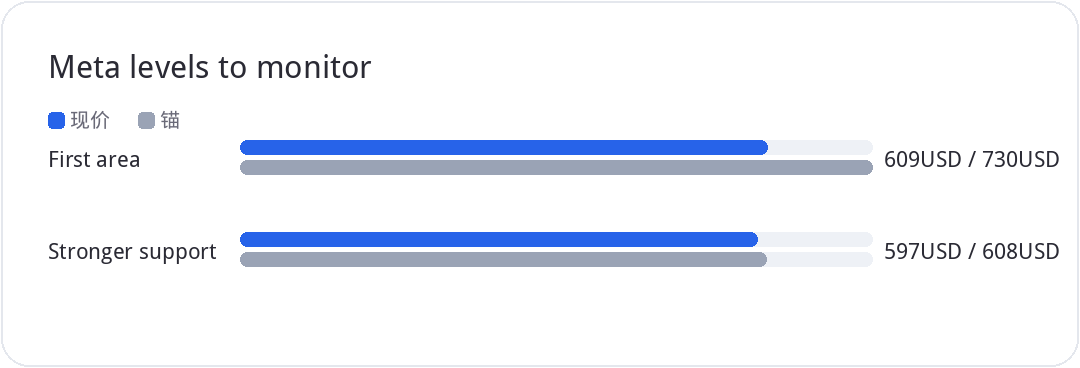
For the chart, $609 to $730 remains a broad area to monitor. A break below $609 would put $604 to $608 and then $597 to $603 into focus; below $597, the current range would weaken materially. These are reference zones, not automatic buy signals. Stabilization in price and clearer guidance would provide better confirmation.
TSLA: Positive free cash flow, but the spending cadence still matters
Tesla reported third-quarter revenue of about $28.046 billion and adjusted EPS of $0.48. Operating cash flow was $6.263 billion, capital expenditures were $4.732 billion, and free cash flow was $1.531 billion. Positive free cash flow is encouraging, but CapEx fell from $5.789 billion in the prior quarter. That makes it important to distinguish operating improvement from the timing of spending.
GAAP operating margin was about 2.6%, versus 5.8% a year earlier. One quarter of stronger cash flow is not yet a durable earnings inflection. Watch whether AI, autonomous-driving, and energy-storage investment continues while margins stabilize. If CapEx rebounds without corresponding revenue and gross-profit improvement, free cash flow may come under pressure again. If spending is cut to protect cash, investors may question the pace of Tesla's growth projects.
The tighter trading range to monitor is $331 to $408, with $315 to $465 capturing a wider range. The setup does not offer an obvious low-valuation long-term entry. Swing traders should define position size and exit levels rather than assume a range must be revisited.
GOOG: Let earnings test the ad-growth concern
The key question for Google is whether ad growth slowed late in the quarter, as one research view suggested. That view is not a confirmed fact and should not be treated as next week's earnings outcome in advance. Meta's slower ad-impression growth is a signal to watch, but it does not prove the entire ad market is cooling. Ad pricing, impressions, retail-ad demand, and cloud results need to be assessed together.
Around $346 is the first long-term level to watch; $311 to $325 and $298 to $308 are lower areas of interest. A break below $298 would raise structural risk. Until the earnings release adds clarity, focus on the result versus expectations rather than making a directional bet on one bearish note.
Short positioning and buybacks still need confirmation
Markets remain caught between semiconductor and AI-investment expectations. Crowded short positioning can fuel a squeeze if prices rise persistently. But if indexes break key support while corporate CapEx disappoints, shorts may simply add to the downside. Positioning alone cannot determine which path wins.
Buybacks can support demand when repurchase windows reopen, but an authorization is not the same as an actual daily purchase and does not guarantee companies will buy at lows. Watch several sessions of volume, breadth, and large-cap tech earnings reactions. A rebound supported by broader participation and expanding volume would be more credible. If only a few index heavyweights carry the tape, AI still has to prove itself through earnings.