Microsoft's AI Business Delivers as Google Faces Another Quarter of Scrutiny

US Stocks · Options · News · Views
Rates stay high as earnings divide tech
Microsoft delivered strong growth and retained positive free cash flow after heavy investment. Google needs another quarter to show that its transition to AI search is not putting lasting pressure on monetization. The two reports are broadly neutral for semiconductors: customers have not reversed their investment plans, but neither has supplied enough new spending detail to justify raising valuations across the group.
On October 28, SPX closed at 7,743.98, up 0.28%; the Nasdaq and Dow gained 0.27% and 0.19%, respectively. The regular session ended before the earnings releases, so those gains cannot be read as an endorsement of the results. In the final after-hours quotes, GOOGL fell about 9.97% from its $324.89 regular close to $292.50. MSFT rose about 2.90% from $531.01 to $546.39. Extended-session prices remain fluid; the first reaction does not settle the following session's direction.
The Federal Reserve voted 10–2 to hold its target rate at 3.75%–4.00%. Cook and Hammack both preferred a 25-basis-point increase. A pause has neither removed inflation pressure nor promised rate cuts. With funding costs still elevated, turning revenue growth into cash matters more than posting an impressive growth rate alone.
Google's results divide along advertising and cloud
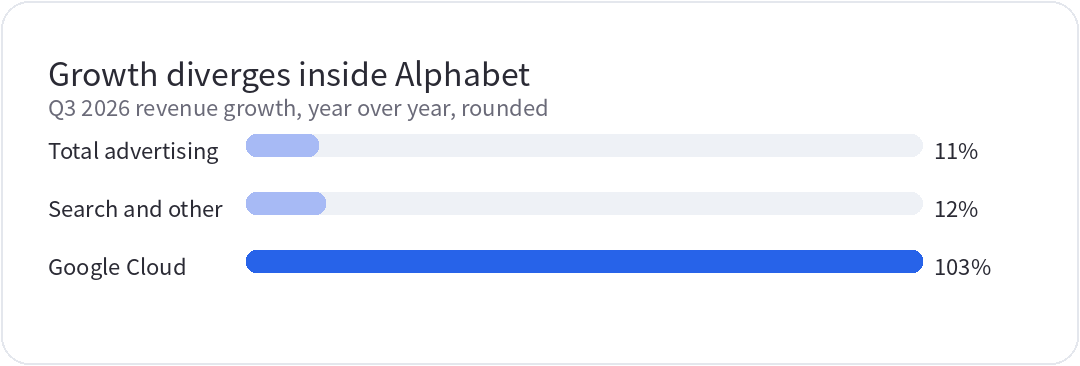
Alphabet's third-quarter revenue rose 25% to $127.577 billion, slightly below market expectations. Advertising revenue increased about 11% to $82.012 billion; Search and other revenue rose 12% to $63.350 billion. Both businesses are growing, but their growth fell short of the market's expectations.
Management says AI is driving search volume, including more commercial queries. More usage does not immediately produce the same advertising revenue per query. The transition to AI search involves changes in ad formats, placement and monetization. If traffic grows before revenue conversion catches up, the traditional profit engine faces pressure. That is a mechanism to test next quarter, not proof from one report that Search has lost its competitive position.
Cloud was the clear bright spot. Google Cloud revenue rose 103% to $30.709 billion. Operating income increased from $3.594 billion to $11.121 billion, for a margin of approximately 36.2%. Growth and profitability both improved, so the group selloff cannot be equated with failed AI demand.
GAAP EPS of $2.12 fell from $2.87 a year earlier. Equity investment losses reduced this quarter's EPS by $0.55. Operating growth, investment marks and market expectations must be assessed separately. The advertising disappointment matters, but investment losses should not all be charged to Search and Cloud.
Give Google another quarter, while watching the cash shortfall
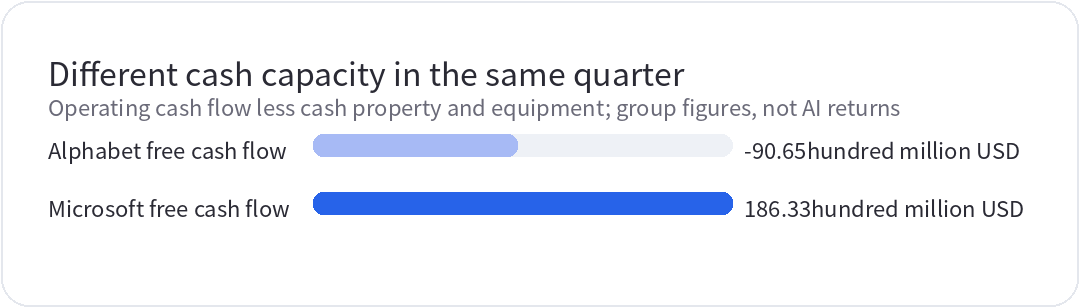
Alphabet generated $42.290 billion in quarterly operating cash flow and spent $51.355 billion on property and equipment. Free cash flow was negative $9.065 billion, its second consecutive negative quarter. Trailing-twelve-month free cash flow was $19.747 billion, down about 73.15% year over year. Rapid cloud growth has not yet taken the group out of its heavy investment phase.
The company maintained its 2026 capital spending forecast of $195 billion–$205 billion and said spending would increase significantly in 2027, with details to follow. It did not raise this year's guidance again in the quarter or establish a firm spending figure for next year.
At quarter-end, $27.6 billion remained available under its at-the-market issuance program. That is capacity for future issuance, not shares already sold. Dilution needs to be reassessed if and when additional shares are issued. Negative quarterly free cash flow does not mean cash is about to run out, but it puts more attention on funding costs and payback periods.
A selloff does not establish that the shares are cheap, and one report does not invalidate the entire AI strategy. Watch the fourth quarter for advertising revenue catching up with query growth, continued cloud profitability and a narrower cash shortfall. Two consecutive quarters of traditional-business weakness alongside rising investment would call for a reassessment of the holding thesis. Improving advertising and cash conversion would provide a fundamental case for recovering some of the selloff.
Microsoft's AI commercialization shows up in cash flow
Microsoft reported its fiscal 2027 first quarter, ended in September, covering the same period as Alphabet's calendar third quarter. Revenue rose 19% to $92.279 billion. Operating income was $45.915 billion, for an approximately 49.8% margin. GAAP EPS was $4.92, while non-GAAP EPS excluding the effect of OpenAI investments was $4.89. The two measures should remain separate.
Azure revenue rose 48% to $33.165 billion, with the same growth rate on reported and constant-currency bases. Commercial remaining performance obligations reached $677 billion. Contracted commitments are not recognized revenue. Still, cloud growth, profit and positive group free cash flow provide firmer evidence of commercialization than demand alone.
Quarterly operating cash flow was $58 billion. Subtracting $39.367 billion in cash purchases of property and equipment leaves approximately $18.633 billion in free cash flow. Operating cash flow grew, but cash capital spending rose faster. Free cash flow stayed positive while falling about 27% year over year. Retaining cash after heavy investment shows greater financial capacity; it does not establish an across-the-board improvement in cash returns. Cash property and equipment spending excludes some new finance leases and is not total capital expenditure. Group free cash flow is also not the stand-alone profit of the AI business.
There were weak spots. Combined Windows OEM and Devices revenue fell 22%. Microsoft 365 commercial seat growth was 5%, but the count now includes paid GitHub seats and is not directly comparable with the old definition. Strong cloud results do not mean every product is accelerating.
Microsoft lowered its calendar-2026 capital spending forecast from $175 billion to approximately $170 billion, reflecting the timing of third-party data-center deliveries. Spending may still accelerate in the second half of fiscal 2027, which corresponds to the first half of calendar 2027. Those periods cannot be combined into a full-calendar-2027 spending commitment. Slower cloud growth or weaker cash conversion would require a less constructive view.
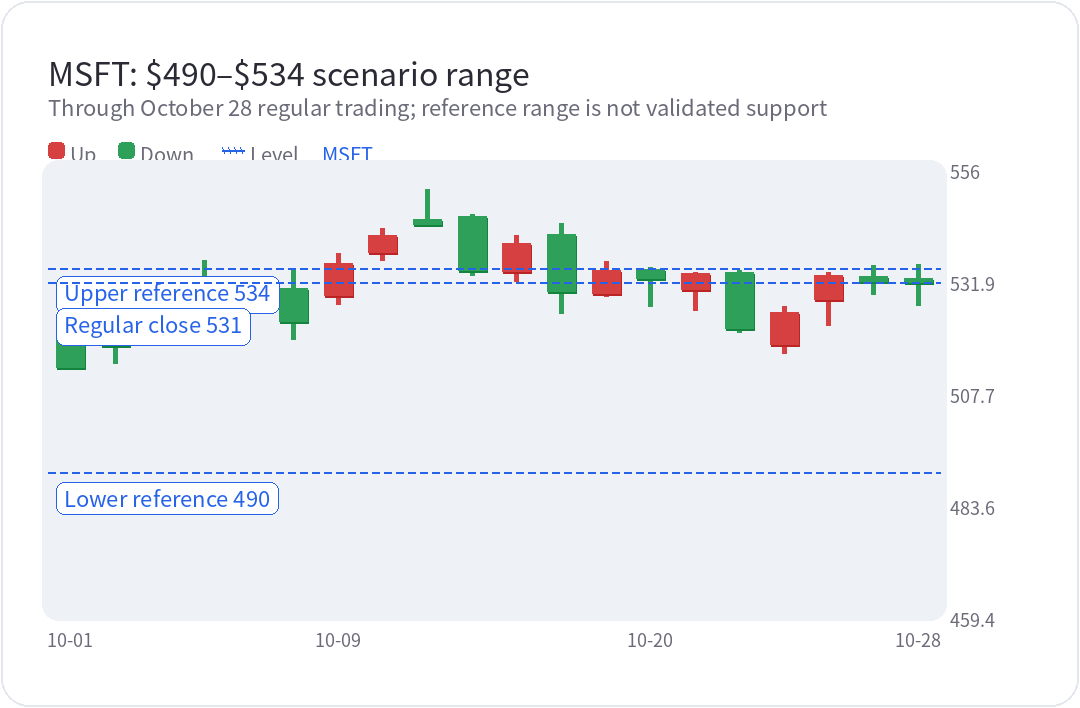
A pullback into $490–$534 can be a range for reassessing the setup, not guaranteed support. The medium-term case depends on cloud growth and cash conversion, not the after-hours gain alone. Wait for the next regular session to confirm the bid, then distinguish post-earnings volatility from a deterioration in operating expectations.
Neutral for semis, with high-expectation tech still vulnerable
Cloud demand remains intact, and Alphabet has not softened its message on 2027 investment. That supports the demand outlook for computing suppliers. Without a clear new spending figure, however, it is difficult to argue that chip valuations should rise across the board.
For NVDA and SOXX, intact demand is only one part of the case. Order conversion, customer funding capacity and current valuations still need to support the shares. More customer spending can lift supplier revenue while depressing the customer's own free cash flow. Returns can diverge across the supply chain.
High-expectation technology stocks such as MRVL, FTNT, CRWD, PANW and PLTR require more than a favorable industry outlook. If their prices depend on years of rapid growth, even a modest disappointment can compress multiples. Without checking growth and valuation company by company, they cannot all be labelled cheap or expensive. Treat the entry price as a separate decision from the industry outlook.
Sharp after-hours declines show widening disagreement over expectations, not a confirmed industry trend. Thin after-hours liquidity and hedging demand can amplify volatility. The first sharp decline cannot establish the eventual direction by itself.
After Amazon, the weekly close matters
AMZN reports next. Watch AWS growth, profit, equipment and lease investment, and the cash left after those bills are paid. Microsoft's answer cannot simply be applied to Amazon, and Google's advertising transition is not a template for every cloud provider.
Thursday also brings GDP and PCE data, which have not yet been released. For QQQ, Wednesday's regular-session low of $720.30 and high of $726.14 define a framework for the next session. Failure to reclaim $720.30 would leave the earnings shock unresolved. Regaining that level and breaking above $726.14 would offer stronger confirmation. These are prior-day reference levels, not long-term support or price targets.
Friday's weekly close will provide another check. Assess whether Microsoft retains its post-earnings bid, Google attracts buyers and semiconductors hold their structure after the next cloud earnings report. Strong cloud results and better cash conversion support selective risk-taking. If customer cash expectations weaken further and suppliers also sell off, tighten exposure rather than defend any particular after-hours quote.