Ten names are carrying 68% of Q3 earnings growth

US Stocks · Options · News · Views
A record close, on lighter volume
Tuesday was three up, one down. Only the Russell finished lower. The S&P 500 finally printed a record close, but volume shrank. The Nasdaq 100 made its third straight record close. Inside the S&P, 339 names rose and 162 fell. Ten of eleven sectors finished green. Health care was the only one down.
The tape is grinding higher and accounts are making new highs, but there is not much new information in it. The next push has to come from earnings. Third-quarter reports start next Thursday. October is already a high-volatility month, and the midterm election is November 3, so the range should widen once the prints begin. The headline is a 27% year-over-year gain in S&P 500 EPS, the highest pre-season growth forecast since 2021. Under the surface it is an oligopoly. The AI semiconductor leaders are already priced for a lot of that growth. How far the index goes from here depends on whether the median name, expected to grow EPS only 9%, can beat.
Utilities: that candle looks like a squeeze
Utilities were the standout sector. CEG signed a power deal with Google (GOOGL) and jumped about 12%, pulling the group up almost 3%. Plenty of power names were up seven or eight points, some ten.
XLU was already a crowded short, with the setup for a squeeze. Tuesday looked like one: gap up, heavy volume, a wide candle with almost no wick. That is not a change in the utility business. A new contract helps CEG's longer-dated orders. It does not mean every name in the sector just got the same contract. Nobody can say how far a squeeze runs. On the chart, XLU still has not cleared 42.4, and the supply from 42.4 up to 46.8 is a stack of real levels.
If you were in utilities from lower, watch for a topping print overhead and take the gain. Treat the sector pop as short covering.
Third quarter: 68% of the 27% comes from ten names
The street expects S&P 500 third-quarter EPS to grow 27% year over year. Goldman calls that the highest pre-season growth forecast since 2021. Open it up and it is oligopoly earnings.
The evidence is the contribution table. AI infrastructure names are expected to drive more than half of the index's EPS growth. The top ten contributors are more than two-thirds of it, specifically 68%, versus 47% in the first quarter and 48% in the second. In Goldman's split, MU alone is 19% and NVDA is 15%. Together they are more than a third of the index's EPS growth, and their earnings increase is larger than the bottom 490 names combined. Then META 7%, GOOGL 6%, AVGO 5%. The list also includes the oil-linked earnings from XOM, CVX, and Marathon Petroleum, plus Boeing.
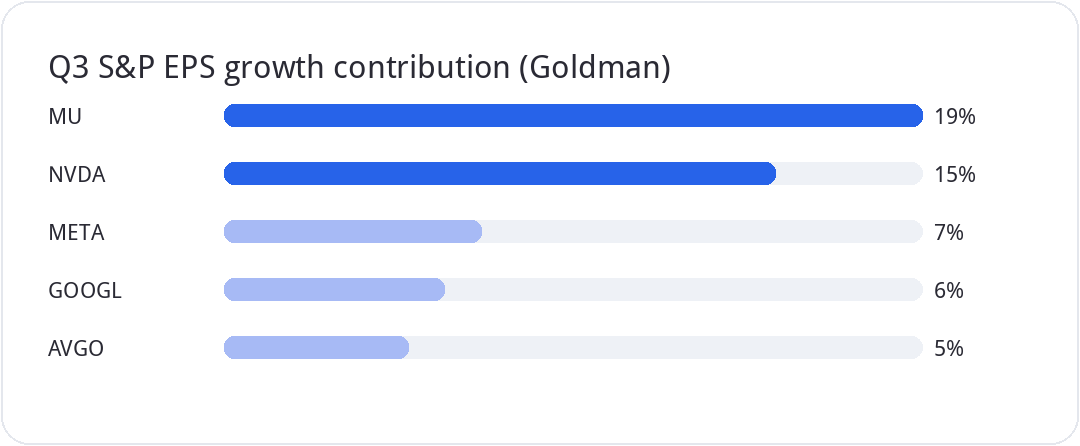
Goldman splits AI into two non-overlapping buckets. AI infrastructure excluding hyperscale data centers is 54% of the quarter's growth. Hyperscale data centers add another 19%. Anything tied to AI is roughly three-quarters of this quarter's S&P earnings growth.
MU shows the mechanism. Last week's report beat on adjusted EPS and revenue, and gross margin went from 45.7% a year ago to 87%. The stock did not rip. The buy side was already ahead of the sell side, the big earnings jump was priced, and the guide was not raised enough. A name up nearly 300% year to date, with EPS up 1003%, has digested that print. Morgan Stanley's line is the right one: the argument has moved from how high earnings can go to how long this can last. A lot of semiconductor companies are running gross margins above 70%. A normal cycle average is about 55%. Twenty or even thirty points above that does not stay forever.
Hold the leaders. Do not count on them to supply the next leg of index upside.
The median is only 9%. That is the variable
Median S&P EPS growth for the third quarter is only 9%, below the second quarter's 14%, with the fourth quarter seen accelerating to 12%. The 9% is a cut. Median profit expectations were taken down about 11 basis points. Input costs are the reason: materials and energy are pushing inflation through the factory, and a lot of companies cannot pass it on, so margins are under pressure. Only technology was revised up in size. Some communication services was revised up. Every other sector's third-quarter estimate was cut.
Sell-side numbers on this middle cohort have been coming down since the start of the year. A lower bar is easier to beat. Most companies beat in a normal season. The question is by how much. The leaders' growth is already in the price. How high and how fast the S&P can go now depends on how far the 9% median names beat. A wide beat can produce catch-up rallies, with semiconductors holding a high, slow grind if they merely meet or beat.
If the book is non-AI or a cyclical that has been soft, this quarter matters. Watch the beat rate in that middle group.
Vietnam: the reform list, and VNM
This section is not the U.S. earnings tape. It is a separate look at Vietnam.
The reform list is already in motion. It was not a surprise dropped on October 6. First, English is being pushed toward a second language in schools. The government scheme runs 2025–2035, and the aim is for English to be compulsory from grade 1 nationwide by 2030. Today it is generally compulsory from grade 3. Second, the minimum wage keeps rising. Regional minimum wages rose about 7.2% on average from January 1, 2026. Third, under the 2024 social insurance law, the minimum contribution period for a pension dropped from 20 years to 15. Fourth, social security and health insurance coverage is widening, including compulsory enrollment for registered business households, plus electronic social-insurance books and electronic health-insurance cards. Fifth, the state is cutting government agencies and administrative headcount, and replacing repeat paper filings with database lookups. Sixth, household and residence registration is going digital. Applications can go through the national public-service portal and VNeID, and agencies are not supposed to ask residents to resubmit information the database already has.
All six point at the same slow variables: skills, pay, social insurance, and a thinner bureaucracy. That is institutional capital.
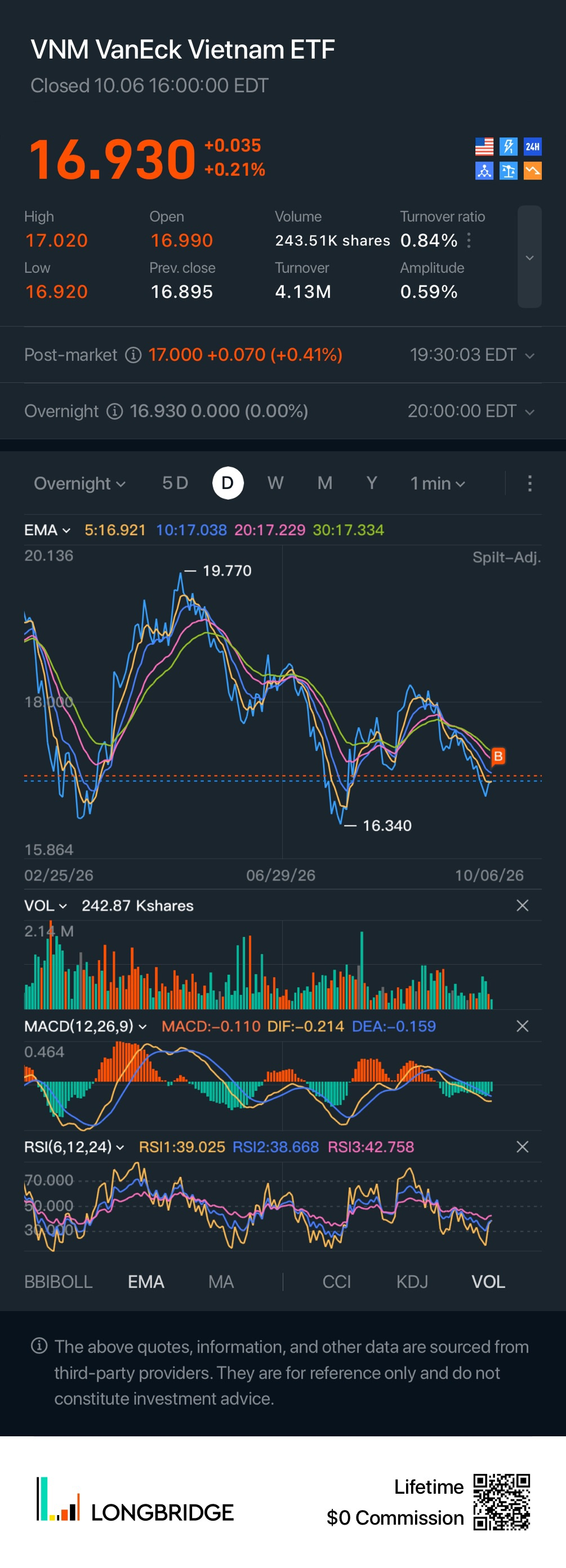
October 6 close 16.930, amplitude 0.59%.
Single names: MRVL, AMD, ISRG, CEG
MRVL raised its revenue outlook and the stock gained almost 6%. The company put a 2030 opportunity at 400 billion dollars, and fiscal 2028 revenue at about 20 billion, up from a prior 15 billion. That is roughly a 30% lift to the fiscal 2028 revenue number. A rough pass, assuming profit up 20%, is about 50 dollars of value. Allowing for margin mix, the working range is 40 to 50 dollars, which would put the January 2028 forward value around 280 to 300. Tuesday's rally landed in that zone. The company's own report still has to confirm it. Overhead, 318 is the marked-up super level. Through it, there is no supply, and the path is the old high and then a new high, right-side continuation. Failure there is a stall risk. Tuesday tagged 301 and was sold. The bounce never cleared the upper-half supply, and the close stayed under it. If the fundamental lift is only 40 to 50 dollars, anything above 300 is already a year expensive.
AMD closed at a recent high on volume. A close at the recent high is neutral. Do not let the intraday shape talk you out of that. Support sits at 605 to 626, then there is a gap down to below 562. The 2027 forward value is 556, so the price is already trading the 2028 forward. After the last report, the setup was a profit surge in the fourth quarter of 2027, with a floor growth rate above 50%. Another 150 to 200 dollars into fiscal 2028 would put a number near 700. When calendar 2027 arrives and the market is pricing the 2028 forward, that can be reasonable. Right now it is early by about a year and a half. Holders can stay on. Semiconductors have broken out and the trend is up. No need to be the first one off while the group is still being carried. Walk it.
ISRG needs a cooler read. Growth is mid-single-digit to low-double-digit. On the 2027 forward, anything above 410 is rich for that pace. The old 50-times prints came with growth above 25%. Growth is about half of that now, so 50 times and higher does not fit. A reasonable band is inside 450. Above 500 is clearly rich. Support below is thick and supply above is thick. A slow crawl to the top of the range at 470 would already be a good outcome. A push through 500 needs the market to be pricing it in mid-2027, around May or June 2027. There is no strong reason to force that break this year. The add zone is under 313. If it does not get there, leave it alone. The lower end of the range can still reach under 280, because the growth rate still has room to be cut.
CEG is a chart call. The AI power shortage, nuclear, and energy complex had a run and then went quiet. Most of Tuesday's jump belongs to the squeeze and short covering, not to a broad fundamental reset. 328 is the level that would put it on the right side of a larger uptrend. It is not there. The day high was 309 and it was sold. Still a defense. If you were in from lower, take the gain.
AMZN had a decent Tuesday. Same comment as GOOGL: discussed enough already.